Three civilizational design principles in the VedA. Civilizational continuity in a changing world. A Perspective on Response of Hindu AchAryAs to Changing Patterns of RtA. The non-response to 15th century European incursions in the South of India. Continuing Non-Response to the 21st Century Globalism.
Continuing Non-Response to the 21st Century Globalism
By Jayant Kalawar, August 29th 2023
In the 21st century there are currently two sets of technologies, which through their ubiquitous use, have become an integral part of the patterns within which humans experience their life cycle: technologies to manage female body cycles, specifically menstrual cycles, contraception, surrogate and ivf birthing. The second is telecommunications and computing technologies. These two technologies have enabled substantial amplification of the feminist movement. Some call it cyberfeminism and networked feminism[i], to characterize the digital revolution, which includes not only internet based social media, but more importantly AI and bio-informatics, leading to emergence of a socialized digital mental life integrally connecting through bio-tech with biological life. These technologies are enablers of both sukshma sharira and sthula sharira in humans.
As we noticed earlier in this paper, invention of double entry bookkeeping and joint stock company organization enabled risk taking projects helped usher in the industrial revolution and made Europe dominant. The feminist movement[ii][iii][iv] along with scalable organizational capability of the internet may in the near future lead to a transhumanist revolution[v]. The civilizational threat (to stability of the materialist state) that AI-Biotech based transhumanist revolution will pose has been given considerable thought: “A general ability to stabilize a vulnerable world would require greatly amplified capacities for preventive policing and global governance”.[vi] The intellectual drivers for such a feminist-transhumanist revolution, enabled by new technologies, are the elite universities in the USA[vii]. The AI-Biotech enabling technologies in the 21st century are likely to play the role of destruction of labor intensive manufacturing based industrial societies, just as in the 17th century industrial technology enabled destruction of India’s flourishing handloom textile industry. The desire and will, the sankalpA, required to accomplish dominion through the industrial revolution in the 17th century was provided by the owners and managers of joint stock companies out of Europe, supported by their Kings. In the 21st century the technology based drive for dominion is more complex: the desire and will for dominion using feminist-transhumanist revolution is provided by a lose interconnected network of tech billionaires, elite US Universities, media, globalized financial markets, financialized Corporates and the US State institutions[viii]. This interconnected network seems to have a life of its own, which current Western social theories are unable to explain and therefore unable to develop public policy. We are muddling through the process of adapting social organization processes and technologies to respond, influence and adapt to the feminist-transhumanist revolution.
How will Hindu AchAryAs respond to emergence of such a transhumanist revolution? Is the response going to be pro-active or are we going to repeat our performance of the past, with Hindu AchAryAs not engaging in questions of social organization and processes (“we do not engage with MllechA” being one such response)?
So where do we go from here? How may a VedA based DharmA renaissance arise, while taking into account a globalized interdependent world with multiple mAnav sanghatanA?
First, the two current major competing paradigms, one based on European Enlightenment (Capitalism with Democratic representative or authoritarian state) and Islam (with its global Ummah and local Masjid), claim universal application to the entire mAnav jAti. Any VedA based renaissance may have to clearly and compellingly articulate in a practical way how it will enable flourishing of the entire mAnav jAti and indeed all inhabitants and ecology on mother Earth, not just BhArata or Hindus.
Second, the current Euro Enlightenment based Artha and Kama ShAstrAs supporting globalized world and potential oncoming feminist-transhumanist revolution is based on a) Newtonian-Einsteinian physics which assumes space-time as fundamental reality and b) evolutionary theory of biology which gives primacy to sthula sharira and does not account for sukshma and KAraNa sharira. Despite their limitations, these theories have enabled technology and engineering which have helped very large numbers of GrihastAs in the mAnav jAti[ix]. For VedA based renaissance to emerge, there may have to be a) a new theory of physics arising out of the concept of space-time being a dependent reality based on prANa-spandanA and b) a new theory of biology based on jIva being seeded in the sthula sharira with the first infusion of prANa from the cosmic spandanA.
Third, any renaissance of Hindu Dharma would have to be led by GrihastA well accomplished in desh-kAl-paristhiti (hence not the renunciate Brahmacharis and Swamis) and at the same time knowledgeable and immersed in the knowledge and practice of understanding the human manifestation as sharira treya. Development of robust explanatory descriptions of the emergent phenomena based on first principles of Hindu shastrAs are going to be one of the necessary conditions for such a renaissance to arise. What may a beginning of such shastra based explanatory descriptions look like? Here is a link to my provocative essay Is Marriage Necessary? , if you would like to explore further on this trail, which may take you away from the rutted path we have habituated ourselves to for quite some time. So, will there be a Hindu Civilization in the future? Perhaps it will depend upon how much fire Hindu grishastas generate through their intellectual Tapasya….
[i] “Cyberfeminism and networked feminism (fourth-wave feminism)
The term cyberfeminism is used to describe the work of feminists interested in theorising, critiquing, and making use of the Internet, cyberspace, and newmedia technologies in general. The term and movement grew out of ‘third-wave’ feminism. However, the exact meaning is still unclear to some: even at the first meeting of cyberfeminists The First Cyberfeminist International (FCI) in Kassel (Germany), participants found it hard to provide a definition, and as a result of discussions, they proposed 100 anti-theses52 (with reference to Martin Luther’s theses) on what cyberfeminism is not. These included, for example, it is not an institution, it is not an ideology, it is not an –ism.
Cyberfeminism is considered to be a predecessor of ‘networked feminism’, which refers generally to feminism on the Internet: for example, mobilising people to take action against sexism, misogyny or gender-based violence against women. One example is the online movement #metoo in 2017, which was a response on social networks from women all over the world to the case of Harvey Weinstein, a Hollywood producer who was accused of sexually harassing female staff in the movie industry.” https://www.coe.int/en/web/gender-matters/feminism-and-women-s-rights-movements
[ii] One way to describe the feminist revolution in terms of AchArya Abhinavgupta’s teachings is that the IchA of Swantantrya, the desire for individuated autonomy, that is carried in each inward breath, finds much more scope of play, for the female sthula sharira, due to technologies for managing menstrual cycles, birth control and birthing.
[iv] “Indian women spend eight times more hours on unpaid care work than men. The patterns are similar across educational qualification, and employment or marital status: women with higher education, or earn their own incomes, do not spend any less time on unpaid care work. Shifting mindsets and rebalancing domestic work requires coordinated effort from key stakeholders, with public-led investments in care infrastructure and services complemented by soft interventions from private sector employers and community-based organisations.” Extracted from https://www.orfonline.org/wp-content/uploads/2022/10/ORF_OccasionalPaper_372_Time-Use-Gender_new.pdf
[v] “Transhumanism is a loosely defined movement that has developed gradually over the past two decades.[1] It promotes an interdisciplinary approach to understanding and evaluating the opportunities for enhancing the human condition and the human organism opened up by the advancement of technology. Attention is given to both present technologies, like genetic engineering and information technology, and anticipated future ones, such as molecular nanotechnology and artificial intelligence.
The enhancement options being discussed include radical extension of human health-span, eradication of disease, elimination of unnecessary suffering, and augmentation of human intellectual, physical, and emotional capacities. Other transhumanist themes include space colonization and the possibility of creating superintelligent machines, along with other potential developments that could profoundly alter the human condition. The ambit is not limited to gadgets and medicine, but encompasses also economic, social, institutional designs, cultural development, and psychological skills and techniques.
Transhumanists view human nature as a work-in-progress, a half-baked beginning that we can learn to remold in desirable ways. Current humanity need not be the endpoint of evolution. Transhumanists hope that by responsible use of science, technology, and other rational means we shall eventually manage to become posthuman, beings with vastly greater capacities than present human beings have.” Extract from https://nickbostrom.com/ethics/values (accessed on October 18th 2022).
[vi] The Vulnerable World Hypothesis, Nick Bostrom, Future of Humanity Institute, University of Oxford Abstract: Scientific and technological progress might change people’s capabilities or incentives in ways that would destabilize civilization. For example, advances in DIY biohacking tools might make it easy for anybody with basic training in biology to kill millions; novel military technologies could trigger arms races in which whoever strikes first has a decisive advantage; or some economically advantageous process may be invented that produces disastrous negative global externalities that are hard to regulate. This paper introduces the concept of a vulnerable world: roughly, one in which there is some level of technological development at which civilization almost certainly gets devastated by default, i.e. unless it has exited the ‘semi-anarchic default condition’. Several counterfactual historical and speculative future vulnerabilities are analyzed and arranged into a typology. A general ability to stabilize a vulnerable world would require greatly amplified capacities for preventive policing and global governance. The vulnerable world hypothesis thus offers a new perspective from which to evaluate the risk-benefit balance of developments towards ubiquitous surveillance or a unipolar world order. Source: https://nickbostrom.com/papers/vulnerable.pdf
[vii]Snakes in the Ganga by Rajiv Malhotra and Vijaya Vishwanathan, 2022, provides insightful perspective of the deep and broad the momentum of this feminist-transhumanist revolution, emerging out of elite US Universities, targeted at BhAratiya society.
Three civilizational design principles in the VedA. Civilizational continuity in a changing world. A Perspective on Response of Hindu AchAryAs to Changing Patterns of RtA. The non-response to 15th century European incursions in the South of India. Continuing Non-Response to the 21st Century Globalism.
The Devi Waiting For Her Children (c) Jayant Kalawar 2019
Besides the invasions from the north west by carriers of the Islamic flag, Europeans began making incursions in the south of India beginning late 15th century. How did Hindu AchAryAs respond to these incursions?
Here is a summary description of selected European incursions, beginning with the Portuguese entry into KeralA and subsequently Goa, Daman and Diu, beginning May 1498, while the Vijayanagara Empire (1336 – 1646) was at its peak. These examples show how newer forms of social organization and technologies enabled non-Hindu cultures to gain control over BhArat over long periods of time, implying that with initiative and curiosity Hindus could have learned these new ways and thus maintained and extended their domain into the Central and Western Asia and Europe 800 years ago.
The invention of double entry book keeping by Money Lenders / Bankers in Europe in general and Italy in particular beginning in the 13th century enabled merchants to lend risky long term project funds[i] (as opposed to specific asset based letters of credit e.g. Hundis) to Kings and Archbishops to finance trade related voyages combined with the cultural project of missionizing Christianity. This funding process helped Spain launch Columbus to the Americas (1492 – the quest was for the Indies but landed in the Americas) and Vasco Da Gama to India (1498). Design and construction of long distance sailing ships with substantial platforms to carry cannons was commissioned through such funds. The financing of these well-armed long distance sailing ships launched Europe’s global imperial project. When Vasco Da Gama arrived in Kozhikode (aka Calicut) he was given permission by theSamoothiri to set up a Portuguese trading post, along with missionaries. Vasco Da Gama headed back to Lisbon. The Portuguese traders were a competition with the Arab traders[ii] who had set up shop in Kozhikode since the 12th century. The Arab traders had their own militia for protection of their assets and also served as the Samoothiri’s navy for protection of the port as well as protection against pirates of the trading ships plying to and from Yemen as well as Egypt. The Arab traders persuaded the Samoothiri to expel the Portuguese. The Portuguese sent a ship with the message of an impending siege by the militia of the Arab traders at the behest of the Samoothiri. The trading post was able to withstand the siege for about 3 months, when 3 Portuguese armed (with cannons) ships arrived. It is said that on just the sight of the armed ships, the soldiers who had laid siege ran away (this may be an exaggeration, but the net result is not in contention). That was in 1503.
The Portuguese thereafter focused on defeating the Arab naval forces that were controlling the Arabian Sea. A pivotal naval war in 1509 ending with victory of the Portuguese armed ships over the joint forces of India based Sultans, the Ottomans and Egypt[iii]. What was the Navy of the Empire of Vijayanagara doing? It seemed to be mostly based out of Honavar and focused on raiding Arab ships plying from Yemen and Aden to the sub-continent with horses bred for cavalry of the Mughals and Sultans who were preparing to attack and occupy Deccan. These naval raids secured a channel for supply of cavalry horses for the Vijayanagara Empire. The Vijayanagara naval commander, Timoji, at Honavar was also reputed to have provided intelligence to the Portuguese armada, enabling its victory in the war against the combined navies of the Sultans of Gujarat, the Ottomans and Egypt in 1509. Subsequently, Timoji is also said to have advised and enabled capture of Goa by Afonso de Albuquerque in 1510. For his services, Timoji was briefly made the interim governor of Goa.
So it may be that it was in 1509 when BhArat began coming under European hegemony, much before European Renaissance which began in late 16th century. Rest was just a matter of time[iv].
Did Hindu AchAryAs guide Hindu kings to establish trading posts in Yemen, Aden, east coast of Africa in the 800 years (since 9th century, during the RashtrakuTA’s there are references to Arab merchants camping on the west coast) prior to Vasco Da Gama’s landing and later (post Vasco Da Gama) in Europe? What efforts were made to secure and learn techniques of double entry book keeping, funding risky long term projects and building out of the new weapons and naval technologies that were coming out of Europe, post Vasco Da GAmA’s landing in Kozhikode?[v]
Extending double entry book keeping to accounting equation gave rise to concept of risky equity by the second half of 16th century Europe. That led to formation of the Joint Stock Company as a social organization. East India Company was one of the joint stock companies (1590), with large number of small investors[vi]. The company was chartered, under the umbrella of the United Kingdom of England and Wales, specifically for investing in a high risk project of setting up trade route to India. The joint stock company social organization and the social contracts with individual investors enabling higher risk ventures continues to be the core social contract across the globe today.
The management of the joint stock company was responsible of making returns for the investors in ways that are legal. In 1757 at battle of Plassey, Jagat Seth financed the war for the East India Company, including bribing Mir Jafar so Robert Clive can win. Did Jagat Seth know about the concept of joint stock company? In 1750s (more than 150 years after its founding) East India Company was in its death throes. Jagat Seth could have taken over the company and made Clive his employee. Was that explored? If not, what kept Hindu money lenders / bankers from learning and exploring about this form of social organization?
In general, people from all over the world came to both the western and eastern shores of India. China sent trading ships to the east coast ports, for example, for millennia. Did Hindus set up trading posts and dominion relationships with any of these countries they sold to? It would be interesting to research to [vii]see whether the exports had to be paid for with gold and silver, since there appears to be little reference to what India was importing. If indeed that is so, then it would make sense that so much gold was available in Deva SthAnAs across India. One could even speculate that the importers of Indian products having been under pressure of producing more gold to buy Indian imports would resort to raiding Indian temples for gold as a way for them to then being able to buy Indian products once again.
All of these ways of social and economic behavior (including especially the non-responses) that I have described above makes sense from within the Hindu culture, which teaches us to act as Karma yogins – produce and consume minimally, and celebrate the Divya ShAktis opulently in their Deva SthAnAs. This may come across as a harmonious stable perspective. However, it leaves the Hindu sanghaTanA vulnerable to attack from non-Hindu sanghaTanAs and to dynamic changes in RtA. To non-Hindu materialist outsiders (the MlechhAs) such practices may come across as infantile, of a people needing to be civilized.
[i]https://core.ac.uk/download/pdf/234631058.pdf The origin of double entry bookkeeping is generally associated with Luca Pacioli. As a matter of fact, the history of accounting cannot be complete without highlighting the wonderful work of Luca Pacioli. His book “Suma de Arithmetia, Geometria, Proportioni et Proportionalita” which was published in 1491 had two chapters – de Computis et Scripturis – describing double entry bookkeeping. His idea reflected the business activities of the Venice at as that time, especially the way they recorded financial transactions. This is to say that even before Pacioli published his book, the Merchants of Venice actually maintained accounting records which of course, they did in a particular way. So in his book, Pacioli simply described this peculiar method used by the early merchants to keep their records. This method was referred to as “the Method of Venice” or “the Italian Method”. This is to say that Luca Pacioli did not invent the double entry system of accounting. He only described the method of accounting practiced at that time.
[ii] “VAsco Da GAmA, for example, might never even have reached India had he not been guided there from the Adrican coast by an experience Arab pilot. And when, after an epic voyage of more than 12,000 miles, he and his men finally did arrive in the subcontinent, they were astonished to be met in the harbour of Calicut by two North African Muslims, both of whom could understand Portuguese” Pp 16-17, Casale, Giancarlo, The Ottoman Age of Exploration, Oxford University Press, 2020.
[iii] The Indian and Arab vessels carried gunpowder weapons, but even the largest dhows, built shell‑first with flexible hulls, were too weakly constructed to mount heavy guns. The Portuguese seized the weather gauge at the start of the engagement, testimony to their ships’ sailing qualities; this enabled them to engage or disengage at will. The Portuguese squadrons apparently fought in line ahead using broadside fire to systematically devastate the more lightly constructed, heavily manned Arab and Indian craft.87 The victory was clearly decisive. Further resistance to the Portuguese at sea was either sporadic or dependent on external support.
The next serious challenge to the Portuguese came in 1508 in the form of an expeditionary force mounted from the Red Sea under Mamluk direction with Ragusan and Venetian technical assistance and based on a hard core of Mediterranean war galleys. Reinforced with a large number of local vessels provided by the Sultan of Gudjerat, the force, under Hussein Pasha, caught a Portuguese squadron at anchor in the River Chaul and attacked with overwhelming numerical superiority. The Portuguese held out for three days before being overwhelmed, eloquent testimony to the defensive power of their vessels and the effectiveness of their ordnance. Of three naos and five caravels engaged, only two caravels got away a circumstance which suggests that the critical determinant of escape was handiness under sail and that the Portuguese could defend the low-lying caravels as well as the tall naos. Whether because of a lack of direction or heavy losses and the need for repairs, Hussein’s squadron retired to Diu where it was caught in port and annihilated the following year by a Portuguese squadron under Almeida. https://www.angelfire.com/ga4/guilmartin.com/Revolution.html
[iv] The core reason for Portuguese naval success, against the Arab-Turkish navy in the Arabian Sea, was superior naval technology emerging out of Europe: Carracks and Caravelles, long sailing ships designed to carry powerful (for that time) heavy cannons. Such development was made possible by funding for risky long term projects becoming available, enabled by double entry book keeping. The Vijayanagara as well as the Arab-Turkish navies used dhonis (powered by oars, rather than long sails) to carry armed infantry, ram the opponents ship, board them and take them over. That dhoni based naval strategy did not stand a chance against the sails and cannon combination, which bombed opposing ships from a distance. Source: Ibid
[v] The Ottoman’s, after the defeat in 1509 in the Arabian Sea, hired Venetian ship builders to build out its navy with the latest available technologies. There is evidence that such technology was available to Hindu kings. For example with Portuguese armada that arrived in 1503, to protect their trading post in Kozhikode, there are references showing that there were agents of weapons sellers from Venice on board that armada. After all, the armada was manned by privateers, mercenaries, in the pay of the King of Portugal dependent on loans funded by merchants. Some cannons were sold to the local Hindu kings, and with training, they were used against the Portuguese armada. That seems to indicate that Hindu kings could potentially have developed allies in Europe for selling their products directly to merchants in Europe, rather than through the trading posts that European kings were forced to send to India when the Ottomans cut off trading routes to India. Was that done? If not, what prevented Hindu kings from doing so?
[vi] Dalrymple, William, The Anarchy, Bloomsbury Publishing Inc, 2019, Pp 7-8 “the EIC was from the very first conceived as a joint stock corporation, open to all investors”. And “The idea of a joint stock company was one of Tudor England’s most brilliant and revolutionary inventions”.
[vii] There are a few exceptions of kings sending trade and dominion missions from the east coast of India going to south east Asia as well as east Asia. Kalinga was one of them – and that came to an end with the invasion by Emperor AshokA about 2300 years ago. The kings of Tamil Nadu also ventured forth in first millennia CE. What caused them to lose influence is a question that needs to be researched.
Aum sri MAtre NamahA Cover art by Jayant Kalawar 2018.
Three civilizational design principles in the VedA. Civilizational continuity in a changing world. A Perspective on Response of Hindu AchAryAs to Changing Patterns of RtA. The non-response to 15th century European incursions in the South of India. Continuing Non-Response to the 21st Century Globalism.
A Perspective on Response of Hindu AchAryAs to Changing Patterns of RtA
By Jayant Kalawar, August 24th 2023
In this section I present a perspective on the changes in patterns, the RtA, that humans experience (given limited human capacity for awareness and self-reflection) and see how the Hindu intellectual culture responded to the changes in the patterns.
The last ice age is supposed to have begun receding in the norther hemisphere of the Earth about 12000 years ago[i]. Perhaps that was the beginning of the 13000 year phase of the approximately 26000 year cycle of the Earth’s precession, when the climate in the northern hemisphere is relatively benign. Assuming the preceding 13000 years was an extended ice age on the Eurasian landmass, one would expect mass migration of those who could move down south – and BhArat becomes one of the most hospitable areas for this period of time. Then beginning about 12000 years reverse migration out of India into northern parts of the Eurasian land mass could have started. Even within those 12000 years, there have been mini ice ages. These mini ice ages may bring mass migrations from the north to down south, often manifesting form of violent raids. Similarly, current research findings seem to point to extended periods of drought between 1500 BCE and 500 BCE, leading to mass migrations – leading to end of Bronze age civilizations, which after many centuries arose again as Iron age civilization. Civilizations built by mAnav sanghatanA over multiple millennia, within these 13000 year phases of the Earth’s precession, may come to an end due to such extended broad and deep events. There are many threads that extend out of such a frame that may lead to ग्लानि of DharmA and responses to such decay and need to be researched[ii]. This paper takes up one response from the Hindu mAnav sanghatanA to such continual destructive war raids on the fertile settled community of the Punjab, by nomadic pastoralists from the North West flying the flag of IslAm: the response of Guru Nanak and the rise of the Sikh Panth.
The frequent raids for plunder, as a means of production for their own mAnav sanghatanA seem to have begun with the well documented raids (at least 17) led by Mohammed Ghaznavi between 1005 CE to 1030 CE. This was followed by even more violent plundering invasion by Timur (the first Mughal) in 1398, ending with the sacking of Delhi after the defeat of the Delhi Sultan at Panipat. A little over a century later, Timur’s great grandson Babur, launched a series of raids on the Punjab and surrounding areas, beginning about 1519 and until 1529. Guru Nanak’s Babur-vaNi articulates the senseless carnage of Babur[iii].
the B ̄abar-v ̄an. ̄ı verses elucidate how Guru Nanak encountered Babur at Saidpur, singing a hymn in Persian language to the tune of a wartime melody, and exposing the greedy tendencies of the aggressor in a most intimate way.
In the last 20 years of his life (to 1539), Guru Nanak developed a response to these frequent plundering raids, through pratyaskha pramAnA (empirical observation) of the desh-kaal-paristhiti, using the lens of the VedA.
How is it that it took Hindu sanghaTanA about 400 years of plundering raids and depredations from the North West to eventually come up with dynamic application of the VedA in response to the threat to DharmA? To get a glimpse of the intellectual landscape of that time in BhArat, I point to the Sarva Darshana SangrahA of Acharya VidyAraNya[iv] (late 13th to late 14th century CE) of Sringeri MathA. The sangrahA covers 16 different darshanAs from CarvAka, Bauddha, JainA, PratibhijnA (with a special respectful mention of AchArya AbhinaguptA’s prolific work) to Sri Adi SamkaraCAryA’s VedAnta. The two darshanAs that were also in play in BhArat at that time, Christianity (in Kerala) and Islam (in Kerala and all along the west coast), are not included in the sangrahA. Clearly those two were not part of BhArat’s intellectual lineage. So they may not make it into the darshana sangrahA. Perhaps there were other documents with critical reviews of these two darshanAs that were made so that their potential threat to the Hindu mAnav sanghtanA could be analyzed through the lens of VedA? If so, the MathAs may be able to provide these documents so that we may learn and benefit from them.
During AchAryA VidyAraNyA’s time Arabs flying the flag of Islam were active on the west coast and especially in Kerala) does not include a critique of the IslAmic darshanA both for understanding their own assumptions and perspective and then applying the lens of the VedA to describe how, under what circumstances, such a Darshana may arise among a mAnav sanghatanA. That would enable formulation of a response. Perhaps the singular focus on personal liberation with de-valuation of samsArA as nothing but suffering through endless re-births, left no room for desire among the highest level of Hindu AchAryAs to invoke the IchA shakti[v] for restabilizing and defending the Hindu sanghatanA. Perhaps such desire and focused intention to re-build DharmA, as a vibrant renewing combination Kama Shastra, Artha ShAstra and Moksha Shastra, have been largely absent among Hindu AchAryA lineages in the last 2500 years?[vi] Does the focus on MimAmsA (interpretation of the VedA), VyAkaraNA (PaNini’s grammar with its logic) and TarkA (debating skills) used to train Hindu AchAryAs lead to dis-association with ability to describe and explain non-VedA based knowledge systems and how they arise in the world, in terms of the VedA? Calling out non-VedA based knowledge systems as either NAstikA or MllechA leads to denial and therefore to vulnerability to attacks.
[i] “Twelve thousand years ago, the great ice sheets retreated at the beginning of the latest interglacial – the Flandrian – allowing humans to return to northern latitudes. This period has been relatively warm, and the climate relatively stable, although it has been slightly colder than the last interglacial, the Eemian, and sea levels are currently at least 3 metres lower – differences that are being closely scrutinised by researchers keen to understand how our climate will develop.” https://www.newscientist.com/article/dn18949-the-history-of-ice-on-earth/
But this respite from the ice is likely to prove short-lived, at least in geological terms. Human effects on the climate notwithstanding, the cycle will continue to turn, the hothouse period will some day come to an end – and the ice sheets will descend again.
[ii] For example nomadic pastoralists have been a mAnav sanghatanA that is not rooted to a geographic locale. Islam played a key role in building a code a conduct among these nomadic pastoralists, so that they could identify as a community, Umma. When times were harsh for these pastoralists, they raid mAnav sanghatanA settled for a long time in specific geographic locale and flourishing – the Hindus of BhArat for example.
[v] Guru Nanak’s MahA VAkya Ik AumkAra Sat NAm is his foundational link to the VedA. The assertion of the MahA VAkya is that there is only one (Ik) Sat (the unchanging),and it is known by the name (Nam) of Aum (AumKAra). The implication is that everything else, other than, Aum, that humans experience is Asat, changing. The rest of Guru NAnak’s VaNis are about drawing in people to come together and chant and do YajnyA. The chanting of the Guru Vanis and acting out the sacrifices are resonant of the Rig VedA verses I quoted at the beginning of this paper.
Guru NAnak guided this yajnyA performed by his community through mantras that he composed and led the sacrifices in tune with the particular desh-kaal-paristhiti that his community found itself in.
[vi] Perhaps it has something to do with the structuring of the AchArya intellectual process mostly involving renunciates since the time of Siddhartha GautamA, who do not have pratyaksha pramAna of the grihastAshrama in general and more importantly in the dynamically changing RtA with desh-kAl-paristhiti? Guru NAnak, a grihastA, accomplished a veritable transformation in his community from within the teachings and guidance of the VedA. Perhaps the Sringeri MathA, to which AchArya VidyAraNya belonged, had published multiple revised versions of the Sarva Darshana SangrahA over the last 600 years? If yes, does it include a closely argued review of the Sikh Panth, followed by debates and discussions to explore and learn and assimilate the learnings of Hindu communities under immense stress responded? If yes, how can those be accessed, discussed publicly and extended to the present times?
The Devi Waiting For Her Children (c) Jayant Kalawar 2019
Three civilizational design principles in the VedA. Civilizational continuity in a changing world. A Perspective on Response of Hindu AchAryAs to Changing Patterns of RtA. The non-response to 15th century European incursions in the South of India. Continuing Non-Response to the 21st Century Globalism.
About 3500 to 2500 years before now, there seems to have been a phase when DharmA in BhArat, was in a long period of decay especially in its political economy (governed by Artha ShAstra) and social formations (governed by KAma shAstra). Research and analysis may be required to understand how the decay in the network of bronze age civilizations[i], beginning about 3500 years before now, played into such decay of DharmA in BhArat. In the meanwhile, the contradictions in the Dharma SutrAs of GautamA for example, provide us a glimpse of how DharmA was applied during that range of time. The SutrAs describe how large masses of the mAnav sanghatanA were to be treated with an iron hand. On the other hand, those entrusted with understanding the changing nature of RtA and use of the over-arching principles given by the Rishis to adapt DharmA to desh-kaal-paristhiti, did not seem to be active. As a reaction to such prevailing decay of DharmA, there seems to have emerged an energetic reaction among the mAnav sanghatanA, around about 2500 years ago there began emerging multiple intellectual responses to this civilizational slide. KautilyA in India. Aristotle in Greece. Han Fei in China. All three intellectual responses were focused on humans as social and political beings – thus the formulations were in terms of KAma and Artha shAstrAs[ii]
At around the same time, BhArat also experienced a different response to this crisis: that of Siddharth Gautama (about 5th century BCE) was one manifestation. Siddhartha Gautama not only gave up his Kingship role (Raj DharmA) but also his role as GrihastashramA. He seems to have articulated the challenge that Hindu AchAryAs had failed to provide guidance on how DharmA practices should adapt to changing in RtA. However, instead of working on re-building VedA based DharmA, Siddhartha Gautama chose a different path: of an assertion that samsArA was full of suffering with personal liberation (NirvANa) the only way out of that suffering of endless births.
Siddhartha GautamA’s response with his pivot to personal liberation as the only path to release from samsArA was mainstreamed by Emperor AshokA about 2300 years ago. Subsequent to this pivot, intellectual conversation on social technologies based on VedAngAs (which form the basis for Artha and Kama shastras, including state building) seems to have come to a stand-still among Hindu AchAryAs[iii]. The capacity on the Hindu civilization to respond to changing dynamic nature of RtA declined. Hindu civilization became vulnerable to attacks from non-Hindu mAnav sanghatanA.
To understand this point of dynamic nature of RtA better, let me take a short diversion. Humans are able to observe certain (very limited) bandwidth of cosmic rhythms (the major part of RtA). For example the rhythm of the Moon that is correlated with the tides, Sun’s annual (solar year, which is how humans broadly share and manage time globally in this epoch) north-south pulsation giving rise to seasons. There are other pulsations of much lower frequency: consider the axial precession of the Earth, which apparently has a frequency of about 25,800 solar years. Our ancestors were cognizant of this. Shastras based on Vedanga Jyotish were an attempt to research and regenerate a more subtle human understanding of RtA. The HC has not tended to researching and developing of this area of knowledge for at least more than a millennia. Consider for example, the possibility that annual solar cycles undergo small changes which accumulate and result in climate changes in the hemispheres, through the progression of precession of the equinox[iv]:
Axial precession makes seasonal contrasts more extreme in one hemisphere and less extreme in the other. Currently perihelion occurs during winter in the Northern Hemisphere and in summer in the Southern Hemisphere. This makes Southern Hemisphere summers hotter and moderates Northern Hemisphere seasonal variations. But in about 13,000 years, axial precession will cause these conditions to flip, with the Northern Hemisphere seeing more extremes in solar radiation and the Southern Hemisphere experiencing more moderate seasonal variations.
There have been variations in seasons even within the 13000 years, which then have given rise to changes in rhythm for humans. This may have lead to seasonal migrations from the steppes to the plains, with annual raids as a means of production against the settled agricultural societies. Not only is RtA dynamic, its patterns reflect the entire range of short and long term spandanA of the cosmos.
The question that arises, if we were to assume dynamic nature of RtA, is: How can mAnav jAti shape and maintain DharmA by continually aligning with dynamic RtA?
Hindu DharmA may have seen diminished capacity to provide the protection (physical security) and abundance (economic security) due to the intellectual pivot away from focus on supporting Grihastashrama and towards aspiring for moksha as the solution to suffering of samsarA, about 2500 years ago. I would like to offer a more contemporary perspective on the challenge that Hindu AchAryAs face if they wish to be responsive and adaptive to dynamic nature of RtA in the 21st century.
As many of you know, there are broadly two types of Artificial Intelligence (AI – neural network programmed big data computing) models. One is classificatory AI model that can be trained once and then used for ever to select cat images from among a large collection of random images. The basic building block for this type of classificatory modeling is the subject-predicate-object model. Same as the core of the VyAkaraNa rules laid down by Maharishi PANini[v] about 2500 years ago for Samskrit. These classificatory models can then begin generating sentences with meaning as well (see for example Open AI GPT-3). Flourishing of Samskrit literature post PANini did that as well.[vi]
The other broad type of AI model is time series based, where it keeps learning and training itself, based on new data it actively looks for. For example Alpha Go. The reinforcement learning method enables opening up new areas that humans have not thought of. The latest example, at this time of writing, is successful use of Alpha Tensor to develop a more efficient way to do matrix multiplications, which are core to AI and require considerable computing power and therefore energy[vii]. Cultures which have this capability to learn from changing environmental patterns may have a better chance of adapting and of being resilient to protect and sustain their Grihastashrama configuration. Hindu AchAryAs due to their focus on personal liberation[viii] (Moksha Shastra) led by non-Grishastas (Brahmacharis, Swamis, renunciates from KAma and Artha) in about the last 2500 years, may have under-cut its cultural intellectual capacity to monitor, learn and respond to changing patterns of RtA. For example, consider how the following popular verse from the Bhagavad Gita was interpreted by most (and perhaps all) SAmpradAyA Gurus[ix] from the Moksha shastra lens (and I then offer an interpretation through my Artha Shastra lens):
कर्मण्येवाधिकारस्ते मा फलेषु कदाचन। मा कर्मफलहेतुर्भूर्मा ते सङ्गोऽस्त्वकर्मणि।।2.47।।[x]
Sri RAmAnujAchAryA’s commentary is helpful in providing perspective for this verse through the Moksha ShAstra lens: “As for obligatory, occasional and desiderative acts taught in the Vedas and associated with some result or other, you, an aspirant established in Sattva, have the right only to perform them”[xi]. First, the AchArYA narrows down the actions to KarmAs (actions) prescribed in the Karma Kanda of the VedAs. He further narrows it down to say the guidance is being given to those already established in Sattva (thus being devoid of Rajas and Tamas). And the guidance is that such individuals should perform actions set forth in the VedAs without asking for anything in return and without expecting any fruits from performing the VedA prescribed Karma KAnda actions.
More recent pracharaks and commentators of the Bhagavad Gita, while recognizing the Gita as a Moksha Shastra, no longer nuance that the actions it references are Karma Kanda actions and applicable only to those established in Sattva (hence free of Rajas and Tamas). The exhortation of doing work without expectations of fruit is made applicable to all actions and to all individuals[xii]. How does such guidance, provided through the Moksha shastra lens, impact functioning of GrihastashramA in a rapidly changing material world that most Hindus experience? From their commentary it is clear that Hindu AchAryAs approach the Bhagavad Gita as a Moksha Shastra. How does that help with encouraging curiosity and initiative required to monitor, learn and adapt to be resilient in a dynamic RtA? How does it assist in applying the desh-kaal-paristhiti principle to enable robust GrihastashramA?
Now let us see how an alternative perspective of the first line of the Bhagavad Gita verse 2-47 from an ArthA perspective may provide different guidance:
You may act (karmaNye) to the best of your competence (the adhikAra you have acquired). However, the fruits from your actions (phaleshu) are not (mA) certain (kadAchana).
Introducing the sense of certainty / uncertainty may enable exploration of the dynamic nature of RtA in particular desh-kaal-paristhiti states. It may open up curiosity for ways of collaborating in the rapidly moving theater of the Devi. An integral part of the script in the Devi’s theater for mAnav sanghatanA is playing out of GrihastAshramA. The backdrop in the theater and other actors and scripts (whether climate, natural environment, multiple mAnav sanghatanA each with its own culture) they speak may keep changing. But the core RtA, enduring pattern, for mAnav sanghatanA is an effective and enduring GrihastAshramA process. So what may help Hindu Civilizational renaissance is VedA based DharmA that is dynamic and cognizant of the changes in RtA to enable flourishing of Hindu GrihastashramA.
MAnav sanghatanA experiences changes in RtA from two broadly different sources: a) the change in patterns of natural environment and b) the change in patterns due to human produced technologies. Given the rapid development of human constructed technologies in the last two hundred years, this source of changing patterns needs to be recognized while considering DharmA configurations to support Grihastashrama in the 21st century. These pattern changes have been introduced by technologies developed mostly by non-Hindu mAnav sanghatanA. Have Hindu grihastAs adapted to these technology driven pattern changes through ad hoc imitation, rather than thoughtful DharmA based adaptation? That is explored in the next section.
[v] In turn based on the core model of human cognition given by the VedAs: prameta-pramANa-prameya.
[vi] Hindu culture is well accomplished in this classificatory model, with its major regional languages adopting PANini’s VyAkaraNa as their grammar, beginning sometime in the 8th-9th century CE (Kannada language is said to be the first regional language to have accomplished this through the RashtrakutA court).
[viii] Hindu AchAryAs use the tools they gain from study of MimAsA (structured interpretation) based on VyAkaraNA (grammar of MaharishI PANinI) and TarkA (logic again based on VyAkaraNA). These are tools help generate abstract mental models that are internally consistent in their logic. They do not support modeling and production of systematized knowledge of the vibrant pulsating cosmos that humans experience with their every breath.
Background: What makes for Hindu Civilization now?
By Jayant Kalawar, August 22nd 2023
This paper describes a futures perspective on VedA based Hindu Civilization, Manav DharmA, in the context of the general angst among many Hindus that Hindu Civilization[i] (HC) may be under attack. I notice three types of responses to this angst. One is to defend HC as a 5000+ year old living civilization with interpretations of texts and cultural processes handed down through the generations as evidence. The second is to call for a renaissance of HC in the context of changing material paradigms. I see Sri Aurobindo’s and Veer Savarkar’s writing in this second approach. The third is the modern secular Indian approach of saying HC belongs to the museum. This paper may be seen as a mix of the first two responses: a search for what led to stagnation and vulnerability of DharmA in the last 2500 years with focus on VedA based Hindu intellectual history, its impact on Hindu mAnav sanghaTanA, and speculation of futures with opportunities and challenges for possibility of renaissance of VedA based DharmA.
I begin by positing three VedA based over-arching architectural principles for designing and constructing flexible, practical, adaptive, resilient mAnav DharmA:
An over-arching VedA principle of cooperation to form mAnav sanghaTanA[ii].
The principle of aligning with RtA, the dynamic patterns of cosmic pulsations at all levels from micro to macro.
The principle of desh-kaal-paristhiti (space-time-circumstance) to ensure responsive flexibility and resilience to ensure aligning with the dynamic unfolding of RtA.
Much of my thinking in this paper is an extension of what I have already presented in my blog post titled Aligning Human Time Cycles with the RtA of the VedA[iii] .
I end that post by quoting what I notice as the over-arching principle of mAnav sanghatanA in the Rig Veda, the last two verses of RV 191.10:
“May all chant the same mantrAs, may they aspire to the same goals, through shared purpose and desire. I will join in your mantra chanting, I will offer the same sacrifices as you so that we may achieve our shared goals.”
“May all have the same intention and desires in their hearts, may all have similar thoughts so that we may connect and work in unison”
The Rishi is guiding us step by step in the process of how mAnav sanghatanA emerges: a) having shared goals b) with shared desires and purpose. The success of this process of accomplishing shared purpose and desires requires c) offering to give up on individual desires (sacrifices, elsewhere known as yagnya) that are inimical to the shared purpose and desires. The pre-requisite of entering into working together, as a mAnav sanghatanA, through individual sacrifice, the Rishi goes on to say, begins with us as individuals generating the same sankalpa, same intentions and therefore the same desires in our hearts. It is this sankalpa, the shared intention and desire, that is open to agency and will, not only in individuals, but as a sanghatanA.
Let’s examine three recent practical examples of Hindu mAnav sanghatanA accomplishing shared purpose and desires to better understand what the Rishi is saying: the Indian struggle for freedom from the British Empire in late 19th and first half of the 20th century[iv], Lokmanya Tilak inspired Ganesh Utsav to bring together Hindu community in early 20th century[v] and the rise of ISKCON over the last 50 years or so[vi].
Does the VedA provide guidance on what kind of shared goals are to be preferred and for what reasons, for mAnav sanghatanA to work in unison? For an answer to that question, let us turn to the second architectural principle of DhArmA: RtA.
My exploration of the theme of RtA in the VedA, which I have covered in my blog post[vii], was focused on examining the role of coordinating individual and social action over time, to ensure social coordination. I described how the development of PanchAnga technology, with daily detailed measurements of time across geographical areas of BhArat, with methods described in VedAnga Jyotisha, was instrumental in enabling large scale actions of mAnav sanghatanA. The panchanga technology enables aligning of the spandanA associated with Earth’s fortnightly interaction with the Moon (which gives rise to tides and pulsation of underground water levels on Earth) and annual interaction with the Sun (which gives rise to the seasons on Earth). The capacity of Hindus to align with the RtA of the Moon and Sun enabled agricultural and market cycles, and therefore the emergence of a flourishing agriculture based civilization.
In this paper, I wish to posit a different, more macro, aspect of RtA for mAnav sanghatanA as a JAti. The manifestation of the jagat through Shristhi by the Shakti aspect of ShivA has an enduring capacity, even while it is ever changing. This enduring capacity we know of as Sthiti. In the current sthiti we find ourselves in, the mAnav jAti is one of the many inter-connected manifestations in the Devi’s jagat[viii]. Currently this mAnav jAti has an enduring quality of hundreds of thousands, if not millions, of solar years. The enduring quality of the manifestation of the mAnav jAti is sustained through reproduction combined with long term nurturing of each generation. Such endurance has been made possible by the human capacity[ix] to produce social organizations as well as supporting technologies. The core organizational process, developed based on insight and guidance from the Rishis of the VedA, that ensures long term endurance of mAnav jAti is GrihastashramA.
That takes us to the last of the three over-arching architectural principles for DharmA design: desh-kaal-paristhiti.
The repetition यदा यदा seem to point to events of DharmA collapsing that have happened in the past and expected to happen many times in the future. The repetition of युगे युगे points to such collapse and subsequent rejuventation is to be expected in many different epochs. In the ItihAsAs we notice descriptions of some deshAs being at peak of practice of DharmA, while others were in a state of DhArmik collapse. Thus at the same time in different spaces, the emergent state of DharmA is seen to be quite different. Similarly in the ItihAsAs we notice that in particular paristhitis (situational contexts) Sri RAma and Sri KrishNa act in ways that may not be considered DhArmic. Hence consideration of the dynamic of paristhiti in DharmA articulation appears to be valid. The proposed over-arching architectural principle of desh-kaal-paristhiti, therefore, appears to be known, in Hindu traditions.
I posit that Rishis of the VedA were aware of that DharmA processes and structures have to keep pace with changing of RtA. They were also aware that RtA of the VedA, a complex dynamic interaction between myriad spandanA of Shakti, would undergo change. There would have to be many updated versions of articulations DharmA SutrAs. It is my understanding[xi] that Gautama’s and Baudhayana’s Dharma sutra treatises themselves reference many previous versions of articulations of DharmA. The Sutras themselves are to be seen as ‘rochak jhanki’[xii], an appreciative snap shot of how DharmA principles were interpreted and applied at a particular time and place, based on interpretation of smritis.There are modern examples which point to capacity of mAnav sanghatanA to develop knowledge to manage and control complex processes that change rapidly over time[xiii]
Should one expect social processes of mAnav sanghatanA to change as the patterns in the environment change, while ensuring that the underlying physics and over-arching architectural principles from the VedA continue to be the foundational building blocks? If so, how is it that we, in the Hindu sanghaTanA, continue to go back and reference operational and user manuals[xiv] for social processes from 2500 years ago, with no new versions generated? That is the question I begin addressing in rest of this paper.
[i] Civilizational angst may have become a global phenomena with the publication of Samuel Huntington’s Clash of Civilizations in 1996. A precursor was Arnold Toynbee’s 1948 Civilization on Trial. Both these reflect the civilizational themes of European Enlightenment as articulated in the 17th (Hobbes) and 18th (Rousseau) centuries. I have provided a perspective of the civilization that has emerged from the European Enlightenment in my bookhttps://www.amazon.com/OUTSIDER-DECONSTRUCTING-EUROPEAN-ENLIGHTENMENT-Death-ebook/dp/B07RHVRV7V
[iv] Indian freedom fighters[iv] shared the goal of SwarAjya. They took up the sankalpa to work towards that goal, while sacrificing their livelihood, and in many cases, their lives. To inspire the mAnav sanghatanA they arose from, they came up with mantras to be chanted together by everyone in that mAnav sanghatanA: Vande MAtaram and Jana Gana Mana. The momentum from this process I just described, in such thread bare outline, manifested the desired result of SwarAjya. The sacrifices and the joint chanting of the mantrAs by the hundreds of millions in the BhArat’s mAnav sanghatanA continues to be felt to be necessary to sustain that desired goal of sustaining SwarAjya. The guidance from the insight of the Rishi of the Rig Veda is so deeply ingrained, in the practitioners of the processes of Hindu culture, that book reading and scholarly knowledge are not a necessary pre-requisite for it to be activated.
[v] LokmAnya Tilak inspired the celebration of Ganesh Utsav in early 20th century as a way of bringing out Hindus visibly into the colonized public square. The celebration became an integral part of LokmAnya. Hundreds of thousands of local community leaders have (and continue to) volunteer their time and funding, as they have over more than a hundred years, to make the shared goal of bringing Hindu practitioners into the public square, by celebration of Ganesh Utsav, an annual success in MahArAshtra. The common shared mantra that is chanted together by the mAnav sanghatanA at the Ganesh Utsav is Jai Dev Jai Dev Jai Mangal Murti[v]. The success of Ganesh Utsav reflects the insight and guidance of the Rishi of the Rig Veda that I have referenced above.
[vi] ISKCON is an international Hindu community institution that evolved out of a shared goal of extending the VaishNava teachings and practice of Chaitanya MahAprabhu of the 15th century globally. Thousands of followers sacrificed their livelihood and way of life and dedicated themselves to this sankalpa. Their common shared mantra that is chanted together by the mAnav sanghatanA of ISKCON throughout the world is Hare KrishNA Hare KrishNA Hare Hare[vi]. ISKCON may be considered as one more successful application of the Rishi’s of insight and guidance on how mAnav sanghatanA come together to work together to bring about change to enable flourishing of the collective.
[viii] VedAnta practitioners may be more familiar with IshwarA’s jagat.
[ix] Humans have a capacity (albeit limited) of self-awareness (emergence of a combination of sAkshi bhAvA and ahamkAra) and self-reflection (pratibhijnA, cognition of objects, including mind, body and sensate world) which gives rise to human language, logic and meaning making, which are then used by the species to attempt to create technologies to shape the objective environment they cognize and at the same time attempt to develop stable structures of social processes, which we name as DharmA, to align with the RtA.
[xi] Based on my reading of Gautama Dharma Sutra by Pandey, Umesh Chandra, 1966 as downloaded from https://ia601600.us.archive.org/13/items/in.ernet.dli.2015.429882/2015.429882.gautama-dharma.pdf , Yaska in his writing circa 7th – 5th century BCE references ancient DharmashastrAs. The book also point out that an especially important aspect (vishesha mahatva) of Dharma SutrAs is that they provide “SAmAjik Jeevan kI rochak jhAnkI”. See Pp 6 – 7 of the publication in the linked document.
[xiii] An example of how mAnav sanghatanA respond to changing situations comes to mind from my vantage point of having some knowledge of development of complex computer systems from mid-20th century into the second decade of the 21st century. The operating, maintenance, training and user manuals for IBM 1620 (card reading) computing machine of the 1950s and 60s was very different from the IBM mainframe computing machines in the 1970 and 80s. There have been many more changes in the supporting operational and maintenance procedures as client-server (including PC based client) systems architectures emerged in the 1990s, and by 2007 began morphing to cloud based mass server side computing, with internet and satellite connectivity enabling a global network of client side devices. I cannot imagine reading up an IBM 1620 card reading computing operations manual and then advising someone on how to operate in a cloud based global environment. On the other hand, the underlying physics and mathematics of how computing machines run, as well as the over arching architectural principles (of reliability, flexibility and responsiveness) have not changed over this times. The point to be made from this diversion is that there is underlying continuity due to factors I just stated. At the same time, due to changes in the connectivity environment (with communications technologies also undergoing generational changes based again on the same physics, maths and overarching architectural principles), the application of these technologies changed the way they were used by mAnav sanghatanA globally. And with that, has changed the operating, maintenance and user manuals for the computing machines that we use.
[xiv] I am pointing to e.g. the Dharma Sutras which are chronicles, ‘rochak jhanki’. I see the Samhitas, Upanishads, Smritis and Vedangas, are sources from which we can glean the physics and the over-arching architectural principles of the Hindu civilization.
This note begins with how I think the sense of time arises in the human mind. I explore how it may have been different in the past in India by describing how time was measured in different ways. I then describe how sense of time changed in the 16th century, which led to massive changes across the globe. I begin by describing how the sense of time may be changing in the 21st century and how it may be negatively impacting human well-being.
Many of us are on social media every day. We notice changes of the view in our account with new entries, whether on Twitter, Instagram or Facebook. Each such change comes with a time stamp. We may not read the time stamp. But we register that the state has changed. What we are viewing on social media is a customized slice of data in massive data bases stored as bytes (of eight bits each). The state of bytes keep changing in fractions of seconds on such massive data bases. Socially we are now living in space where collectively we make changes to the state (of the data bases) at speeds which individual human minds cannot comprehend.
This lack of being able to comprehend rapid change of state (too much information?) seems to result in individuals not being able to make sense of the world they live in. Collectively it may lead humans to not being able to have a shared narrative to act out what may be a meaningful theater of life that gives a sense of human flourishing to most, if not all humans.
The breakdown in capacity to produce shared narratives may be based in humans not being able to be in rhythm with the accelerated speed of social time in the 21st century.
It may be helpful to start with a caveat that what I say is highly speculative, based on very limited information. And that limit is within the highly limited capacity of humans to know the Cosmos, most of which is beyond access to the 5 ways of sensing that the human species is endowed with.
I am presenting Rta as a different way of sensing time. It is a different way of sensing time, than the one we are used to in the 21st century. In the 21st century we sense time in terms of social contracts we have entered into. A contract to work, to attend school, to see a patient, get a haircut. These are all social contracts among humans. Time is sensed in terms of change of state of contracts among humans. If the work contract on an assembly line requires production of 3 widgets per muinute, time is sensed in terms of whether the contract was met or not.
This way of sensing time became the norm post this so-called European Enlightenment, when modern Humans became the de facto center of the Cosmos. Individual and group desires of modern Humans became the focus of our lives. The constitution of a nation-state is an example of a social contract franework, albeit among the elites who have drawn it up (sometimes called the Constituent Assembly) on behalf of the citizens of the nation. All the citizens then develop their own contracts amongst themselves within the overarching framework of this social contract framework called the Constitution. Since this “European Enlightenment” in the 16th century such Constituitional frameworks have been developed to be human centric and specifically disconnected from the Cosmos. Only humans seem to exist for purposes of the Constitution, which is supposed to be the foundation of the nation-state. Individual and groups of citizens then develop their own contracts amongst themselves within the overarching framework of this social contract framework called the Constitution.
Tracking each tiny movement towards or away from fruition of these desires became the obsession of these particular social contracts among individuals and groups. That is the sense of time that most Humans live in. Now in the 21st century, now down to micro seconds with a combination of computing and communication technologies. This level of time tracking is beyond comprehension by Human mental cycles. For example, fast paced gaming videos playing on virtual reality devices in what is now increasingly labeled the metaverse. It should not be a wonder that humans increasingly are not able to differentiate between reality and fiction.
The word Rta appears more than 390 times[i] in the Rig version of the VedA. As with any word, Rta has been interpreted in multiple ways. Here I am interpreting Rta as an articulation of a certain regularity of pattern of change in whatever it is that humans are perceiving. We experience time through these patterns of change that we notice.
The Insight-givers (Rishis) of the Rig Veda[ii] observed these patterns and guidance on how to align with these patterns of change, Rta, followed. The ‘how to align’ attempts to provide structure to align with time cycle pattern that Humans perceive at various levels. The intention was to provide guidance on how to live harmoniously with the Cosmos. Networks of such Rta aligning structures may be seen as DharmA: that which supports Humans to live harmoniously with the Cosmos.
Insights of the Rishis as given in the Veda (Rig, Saam, Yajur and Atharva) were distilled in the Upanishads. The Rig Veda has 10,600 verses. There is one Upanishad associated with Rig Veda: Aitereya Upanishad[iii], which has 33 verses. Such concentrated distillation of the wisdom of the VedA can make it challenging for many people to understand the gist
The Upanishads[iv] in turn became the basis for developing DarshanAs. Each DarshanA[v] presents a specific model of how Humans function in the Cosmos. One such DarshanA is Vedanta. And within Vedanta, there is Advaita VedAnta.
In this note I am using the (to the best of my limited knowledge) Advaita VedAnta DarshanA, as articulated by Adi ShankarAcharya, to first describe the place of Humans in the Cosmos. And then to describe the different types of Cosmic patterns, Rta, observed by Humans, to which they may attempt to align with. For these descriptions from within Advaita VedAnta teachings, I use the lens of pulsations, SpandanA from Kashmir Shaivism.
There is one singular Cosmic pulsation. A pulsation is a rhythmic pattern of expansion and contraction. The rhythmic pulsation gives rise to sense of time in the Human observer.
Desires arise within this one singular Cosmic pulsation.
One of these desires is to manifest and enjoy play as Human on the Cosmic playground of innumerable manifest desires as Human.
The singular Cosmic pulsation takes on a role of non-acting, non-judgemental Witness, the Sakshi, as this Human manifestation arises.
The desire to be Human gives rise to a Knowledge pulsation that is described as the Intellect.
The Knowledge pulsation arises out of the Sakshi, the Witness pulsation. It is dependent on the Witness pulsation, which is in turn an integral aspect of the singular Cosmic pulsation. Disturbances arise in the Knowledge pulsation. These disturbances are thoughts arising and receding withing the Knowledge pulsation. Thoughts are transient. Being transient, Knowledge based on transient thoughts are considered less real. They may have certain patterns. One of the key thought pattern that arises is the ‘I’ ness (Aham kArA), the ‘I am”. But the transient nature of these thought patterns makes the patterns less reliable as guide to understanding truths about the Cosmos (when compared to the complete unchanging steadiness of the Sakshi, the Witness). The ‘I am’ thought pattern also rises and recedes. But through memory capacity gives a false sense ofindependent continuity and hence a false sense of separate identity.
Out of the Knowledge Pulsation arise the five Sense pulsations, each with its specific limited functional capabilities to connect with a subset of the innumerable other manifestations, which we know of as objects outside of us, in the Cosmos.
Out of the collective of the five Sense pulsations arises the manifestation of pulsations of the physical body. The physical body pulsations have the capacity to inter-act with a certain narrow range of what Humans perceive as object manifestations in the Cosmos.
The Knowledge pulsation together with the Sense pulsations observe the patterns in the object manifestations. The patterns in the physical body manifestations are also observed. However, the Knowledge pulsation is unable to have knowledge of itself until and unless there is guidance to withdraw and observe its own thought patterns.
This is a very highly simplified[vi] description of the pulsation constituents of that makes for being Human. This background is the basis for the description of how Rta was observed and how actions of the physical body to align with these objective Cosmic patterns were designed and practiced within Indic traditions.
I present examples three of the patterns which were observed as time cycles in the Indian traditions and ways to align with Rta: 1. Astronomical patterns for managing social and economic movement in time: time keeping through movement of Sun and Moon in the background of Asterisms, including calendrical time. 2. Thought patterns to manage individual actions in time: The entanglement of breath patterns with thought patterns. 3. Patterns of hormonal cycles to manage individual physical body: example of menstrual cycle. For each of these examples we will explore how the Veda based Rta based Dharma actions worked and then note what is happening now in the 21st century.
Human in India pick up patterns of Sky movements of the Sun and the Moon in the background of the Stars. They notice patterns on Earth which apparently correlate to the patterns in the Sky.
Sun and the seasons. Moon and the tides.
Then they figure out that the patterns change from when they north to south, east to west.
They come up with a way to measure the movement of the Moon vis a vis the Sun. It takes 30 Sun rises for the Moon to be with the Sun, approximately. They figure Moon is going around in circles. That means the Moon moves ahead about 12 deg ahead of the Moon between 2 Sunrises. But the Moon has a wobble and it intersects the Sun’s apparent rotation around the Earth at about an angle of 5 deg twice a month. Once when it goes from South to North (they named in Rahu, the north node) and then when it goes from the North to South (they named in Ketu, the south node). How to keep track of all this on a daily basis and almost every village? They were also aware of the precession of the Earth and the nutation of the precession angle itself, based on their observation of how the apparently fixed North Star changed over millennia.
How was this complex time keeping accomplished? By having a disciplined group do the daily work of time keeping through observations of the sky at each big village in every area of human habitation in India. How was this done without building out monasteries and institutions which require state patronage? It was done by creating norms of having Brahmans, a group of people who committed themselves to being disciplined to be up every day to measure the number of degrees that the Moon had traveled since the previous Sunrise. They did this three times a day, every day: Sunrise, when the Sun was at the zenith in the sky and at Sunset. The procedure they followed was called SandhyA VandanA: connecting to the sky at the conjunctions of the Sun with particular positions of the sky. In modern terms Sandhya VandanA is called a ritual. It was a procedure designed to maintain time keeping operation on a daily basis across the geography of India. The Sandhya VandanA procedure and other such procedures were designed to help manage many time cycles. This particular procedure, SandhyA VandanA, was designed to enable social time keeping cycles through daily observation of the sky map. These daily observations were meticulously collated into PanchAng (roughly translated as almanac). Each geographical area had its own PanchAng, which was then shared and coordinated across the areas through the regional King’s court.
What were the social and economic benefits of such social time keeping? A shared social time keeping system is a central core to coordinating work and social interactions between working groups and families. PanchAng was used to inform people when to prepare the fields, sow, irrigate, harvest. It was used to set the local market days and times, to identify marriage seasons so that they would not overlap with work seasons. This social time keeping was one of the corner stones of India having been productive and socially and economically stable until the advent of “European Enlightenment”[vii].
The productive and socially and economically stable conditions in India were a reflection of the attempt at designing and implementing a way of living that would align with Rta, the Cosmic cycles. The Rig VedA promises that when Humans align with the Cosmic cycles, the Rta, they are rewarded with abundance, health and capacity to collaborate and minimize harm to each other and the environment[viii].
Brahmans were assigned the role of keeping time, which required strict daily discipline and austere life (including need for social distancing to minimize being ill), since they had to perform certain procedures and make key observations every day, beginning before dawn. Their cumulative services were required by all the people together and not just people local to a village. In return they were assured protection by the King from any harm, they were given a small allowance for their time keeping services. In addition, they were given the function of teaching in PathshAlAs, schools. Since they were trained to be keen observers, they also developed Ayurveda, using which they could also offer services as healers.
Brahmans passed on their knowledge generation to generation by practicing partial endogamy. Partial, because the norm was that the sons could go East to offer their services to Kings and villages which did not have time keepers. There they could marry a local woman and start a family. The norm was that Brahman women were married to Brahman men to the West. So the Vedic frontier expanded to the East beyond India through this process of Brahman sons going East to offer services and marrying locally. It was through such service based knowledge transfer that Vedic guidance that aligning with Rta would make for a harmonious way of life came to be in Burma, Thailand, Cambodia and other South East Asian countries[ix], without invasions or mass migrations out of India.
There may have been push backs within Indic traditions to the claim that attempting to living a life through alignment with Rta is sufficient to ensure harmonious life (that it is necessary was not challenged) makes for harmony by the Uttara Mimamsins more than 3 millennia ago and later during the time of the Buddha about 500 BCE. The series of Islamic invasions from about 1100 CE onwards caused many dislocations, but did not displace the Rta based time keeping processes in India. It was British colonization, which brought with it a highly centralized way of time keeping that finally put paid to the highly de-centralized process of Brahmans being the time keepers through daily observations wrapped in strict discipline of an austere life.
The Gregorian Calendar reform of 1582 by the Roman Catholic Church was a key factor in displacing the central time keeping role of Brahmans in India. Jesuits who led the calendar reform committee on behalf of the Church went to Kerala in India[x], to be trained in Vedanga Jyotisha, which form the basis of forming sky maps and measuring and developing accurate almanacs.
With the Gregorian Calendar reform of 1582, Europe had the timekeeping corner stone required for social and material abundance that India had enjoyed for many millennia prior. That followed in 1600 the establishment of the British East India Company. By about 1800, the British Greenwich Meant Time became the central time keeper for the global commercial world. The Human centered world of social contracts was firmly in control. The world of the Rta, the process of alignment with Rta, the Cosmic patterns, the way of life for a large fraction of humans, under the guidance of the VedA, faded into the foggy past. As if to make sure that this way of life of alignment with Cosmic cycles would not re-emerge, Brahmans were and continue to be vilified as the evil ones. But for the British East India Company’s benign exploitation of India and it people to a level of poverty and famine unseen before (by moving them into opium cultivation in Bengal and Bihar and cotton cultivation in Gujarat for example), India would still have been a backward degenerate dark hole of humanity, if we are to believe western scholars.
From then on Time arose from social contracts with Humans as center of the Cosmos. No longer in sync with the Cosmic cycles.
The global impact of the disconnection from the Cosmic cycles, the Rta, through social contract driven Time, has been death in three acts of ecocide, fratricide (from the Mother Divine’s perspective we are all Her children, hence fratricide rather than genocide seems more appropriate) and suicide[xi].
As the process of attempting to align with Cosmic time cycles receded into the fog of social memory, the time cycles spawned by social contracts, with a human centered cosmos, led to increased disturbance in individual and group physical and mental health.
Civilization arising out of the VedA not only speaks to the Cosmic time cycles as observed by the sense pulsations in space, it also speaks to the Cosmic time cycles in the physical human body and the human mind. For Cosmic time cycles permeate every pulsation. These different Cosmic time cycles are entangled with each other.
The time cycles of the human mind are experienced as thought patterns. Thoughts cycles are closely connected breath cycles. As breath cycles slow down, so do thought cycles. As the frequency of breath cycles slows down and their amplitude grows (deeper in and out breaths), the frequency of thought cycles slows down and the amplitude of thought increases (enabling keener observation with deeper insights).
As first two steps, of the Sandhya Vandana procedure to monitor the Cosmic time cycles that the Brahmans performed three times every day, were Surya Namaskar (a physical movement to align the physical body cycles) and then praNAyAma, exercises to slow down frequency of thoughts, while increasing amplitude (insight depth) of individual thought.
Surya Namaskar is a series of postures from the discipline of the Indic tradition of Hatha Yoga. As are the particular PrAnAyam steps that are integrated into the Sandhya VandanA procedure.
As malaise rose in the social contracts based human centric world, there have been attempts to graft Hatha Yoga based procedures on to modern lifestyles. They fail to deliver. The intention of performing the procedures is not to align with Cosmic cycles. In the modern usage, it is an attempt to perform better in the world of human centric social contracts time cycles which is alienated / disassociated from the Cosmic cycles.
The guidance in the VedA is that for blessings of abundant flourishing to be showered, alignment with Cosmic time cycles is required. Offering / giving up / sacrificing of human desires that are obstacles in the way of such alignment with Cosmic time cycles is required to prepare and enable humans to align with the Cosmic time cycles. This process of offering / giving up / sacrificing of obstacle making desires is Yajnya. Yajnya thus becomes a pre-requisite to attempting to function in consonance with Rta, the Cosmic time cycles.
In the globalized modern world we are far away from even having the intention to align with Cosmic time cycles, Rta. We are even farther away from even beginning to contemplate on which of our desires, ably accelerated by the time cycles of the human centric social contracts world, we may want to offer as sacrifice so that the intention to align with Rta may arise.
In the meanwhile, we have high thought frequencies at shallow amplitudes. The Knowledge pulsation in almost all humans is not able to deliver wisdom. It gives rise to dissonance from Rta and the widespread malaise which we are quite familiar with.
I wrote the foreword for Rtu Vidya: Ancient Science behind Menstrual Practices[xii] in 2020. Here is an extract from it:
“I do not mean that as an empty flourish. The female human plays a most critical role in the flourishing of the human manifestation. Yet, modernity completely subsumes woman’s roe as the creatrix and mother, by putting gross material flourishing on the pedestal. All metrics which govern our modern way of life, whether in terms of time or effort (think productivity, efficiency, effectiveness etc.) makes us focus on exploitation of what modernity deems to be resources for material production and consumption. Menstruation plays a central role in a woman’s life cycle. The technology to manage and suppress menstrual cycles so that women’s bodies are free to shift the focus on increasing material productivity (marketed as economic freedom) is a central toxic hallmark of modernity. And we are all participants in sustaining these modern processes. Many of us are actively subverting any opposition to modernity (and how it shapes women, whether through the stance of ‘conservative’ modernity or ‘progressive’ modernity) that may arise from competing cultural paradigms that describe creative roles women play in human flourishing. Rtu Vidya offers a competing vision of humans and women to the one offered up by the modern paradigm. As the book gets traction and attention, it is likely to attract vehement opposition from many moderns who see freedom only in narrow economic terms and in effect as the unbounded opportunity to bond ourselves to the treadmill of ever increasing material efficiency demanded as sacrifice at the altar of Capital.”
As the reader may have noticed, Civilization based on VedA provides guidance on aligning with Cosmic time cycles at thought, sensory, hormonal and physical levels. One of the key time cycles for Humans are the endocrine (hormonal) cycles. We know of the Circadian rhythm, the 24 hour time cycle in Humans (and most mammals) which is aligned with the Earth’s rotation and the apparent revolution of the Sun around the Earth. Disruption of that key alignment is known to cause “decreased cognitive performance and increased propensity to develop obesity, diabetes, and cancer. Many hormonal factors show robust diurnal secretion rhythms, some of which are involved in mediating clock output from the brain to peripheral tissues.”[xiii] We are also aware of that the human centric social contracts based time cycle has disregarded alignments with all Cosmic cycles. While there have been research on impact of disruption of Circadian rhythms on humans, the research of impact of disruption of menstrual cycles on women is not done. Research is done on how best to regulate and / or suppress menstrual cycles and therefore disrupt the hormonal cycles in women, so that they become available to provide labor to the social contracts focused time cycles.
The book Rtu Vidya describes practices based on principles of Rta alignment from the VedA that were designed to ensure menstrual health. While women from living Indic cultures are likely to benefit most from this book, I would suggest women from other cultures may see this book as a way to critique and change menstrual practices in their own cultures to align them better with the Cosmic cycles and ensure better menstrual health.
We are where we are. Perhaps we are at a fork in the road: lets imagine there are three alternate routes to choose from: one is to keep muddling along as we are, do nothing. Second may be to hope techno financiers will lead us into a techno utopia and we can build ourselves an artificial world and make ourselves into transhumans (half human half machine) to adapt into the artificial world with its artificial time cycles[xiv]. The third may be to attempt to renew the effort to align with the Cosmic time cycles.
Here I will address the third alternative.
We cannot go back to a point a couple of millennia ago, when there seems to have been a serious attempt made to socially organize to be in consonance with Rta. We can learn from that experience. We can see where we are today. And then begin with the intention that we want to once again begin to focus on being aligned with the Cosmic cycles at all levels. And be open to judiciously using current technology to do so.
A practical way to begin in this direction may be to fully restore alignment with the circadian rhythm for all humans (will require substantial change in current economic structure, which functions 24/7/365), along with metabolic cycles (implying nutritious food available to all, but would imply substantial change to the current food growing, prep and delivery system) and support for menstrual health for women through alignment with their cycles (would require substantial changes in work and career related expectations for women).
At the individual level one may begin with aligning breathing pattern with thought pattern, with low frequency and high amplitude.
My take away from this note is that the chances for social harmony among humans may be enhanced by human individuals and groups sacrificing their desires that conflict with the effort required to align with Cosmic time cycles. The guidance on how to align with Rta is all down to earth and practical suggestions. They are neither esoteric nor mystical. Also, while may be a partial solution, based on historical experience, it may be the most helpful steps to take towards a new global renaissance.
The Rig Veda says that when Humans align with Rta, they are blessed with abundance at all levels. Humans aligned with Rta cooperate with each other and in unison work together to achieve their shared goal. That leads me to close this note this note with the (very practical down to earth) the last two verses of the Rig Veda (10th Mandala, 191 Sukta, 3&4th verse)[xv] :
“May all chant the same mantrAs, may they aspire to the same goals, through shared purpose and desire. I will join in your mantra chanting, I will offer the same sacrifices as you so that we may achieve our shared goals.”
“May all have the same intention and desires in their hearts, may all have similar thoughts so that we may connect and work in unison”
[i]https://en.wikipedia.org/wiki/%E1%B9%9Ata “In the Rigveda, the term Ṛta appears as many as 390 times, and has been characterized as “the one concept which pervades the whole of Ṛgvedic thought”.[16] The cosmic order, Ṛta, has three features:[17]
Gati, the continuous movement or change.
Samghatna, a system based on interdependent parts.
Niyati, an inherent order of interdependence and movement.”
[ii] The NAsadiya Sukta of the Rig VedA ( click on this link and scroll down to Text and translation: https://en.wikipedia.org/wiki/Nasadiya_Sukta ) is often quoted as deepest insight of the VedA. Each of its verses is a contemplative ocean. Deep dives into these oceans resulted in the insights embedded in the Upanishads and subsequent development of the TantrAs.
[iii]https://en.wikipedia.org/wiki/Aitareya_Upanishad Aitareya Upanishad discusses three philosophical themes: first, that the world and man is the creation of the Atman (Universal Self); second, the theory that the Atman undergoes threefold birth; third, that Consciousness is the essence of Atman.[2]
[vii] I use quote marks for “European Enlightenment” to signify that as an outsider I see it as a fountain of epistemic violence unleashed against all outsider cultures, which continues to destroy many millennia of knowledge that human cultures generated. One of the favored epistemic weapons used is to deconstruct, label and analyze those cultures as degenerate, while at the same time be sweetly condescending and patronizing. This is a common weapon in the arsenal of all those practicing currently in Western academia, without exception. Marx’s 1850s formulation of the Asiatic mode of production, his view of the “hereditary village republics” was based on his reading of the British History of India by James Mill. It completely ignored the conceptual world view of the Cosmos based on the VedA that formed the basis of attempting to design a way of life that aligns with Rta, the entangled Cosmic cycles that we dimly observe with the limited cognitive capacity that we as Humans have. After all the Philosopher, Hegel, in 1830, had declared Europe had nothing to learn from Asia. That henceforth it is Europe that is going to teach the world.
[viii] Those who wish to deep dive into Rig VedA, this Hindi translation may be a useful starting point: https://vedicheritage.gov.in/flipbook/Rigveda_Subodh_Bhasya_Vol_IV/#book/9 . English translations lose the substance and context due to the Western lens used in the translation, which misses out on understanding Vedic view of the Cosmos. See the English translation by H.H. Wilson here (free online) and notice how it interpolates words such as worshippers and gods which are not there in the Rig Veda (use of such words change the meaning of the VedA to fit into Western Theology and dependent ideologies, including those spawned by European Enlightenment).
[x] Pp 331 Raju, C.K. The Eleven Pictures of Time, The Physics, Philosophy, and Politics of Time Belief, SAGE Publications, 2003. “The Jesuit Christoph Clavius who eventually headed the calendar reform committee had studied at Cimbra under Pedro Nunes, the most famous European navigational theorist of the time. Clavius reformed the curriculum of Jesuit priests at Collegio Romano , to introduce (practical) methematics into it, as noted earlier, and himself wrote a text on practical mathematics. From among the first batch of Jesuits, so trained in mathematics and navigation, the most capable , like Matteo Ricci, were sent to collect information about timekeeping from India, to help in Clavius’s reform of the Gregorian calendar.”
The Destroyer of Ignorance and Confusion – Aum Namo KAlarAtreya NamAhA (Source: Wikipedia, Devi Kalratri, Sanghasri, Kalighat, Kolkata, 2010)
Background to this post
As I was observing how actuals for the current (April 2020) Wuhan Virus pandemic in USA were tracking quite well to the slope (not the levels) in the graphics produced by my Jyotish based model (posted on April 6th), I received a suggestion[i] that it may be helpful to assess what Jyotish factors drove the Spanish Flu pandemic of 1918 – 1919 in USA.
So in this post I am looking at how the planetary patterns played out in the three waves of the 1918-1919 pandemic in USA. I then compare the 1918-1919 planetary patterns to the planetary patterns that will be in play between now and summer of 2021, using the Systems Approach to Mundane Vedic Astrology[ii]. The conclusion, which you can read in more detail towards the end, is that there appears to be a potential for two waves of the Wuhan Virus to arise in the USA:
Jyotish indicators show that there is some potential for what may be a mild second wave of Wuhan Virus in USA during mid May 2020 to end July 2020. This second wave may be seen as a continuance of the current wave (as I write this in mid-April 2020). There is more of a potential for civil and political disharmony and economic hardship in USA in May and June 2020, but that is from a different set of planetary drivers, which I may cover in a separate post (in this post I am focusing on the pandemic concerns).
There are indications of a third wave of Wuhan Virus arising between mid-October 2020 and February 2021, with a peak in December 2020 (which happens to coincide with the typical seasonal flu period in USA, beginning with spread of contagion from the Thanksgiving Holiday, through to Christmas Holidays and the New Year). My analysis based on Systems Approach Jyotish indicates that if at all such a third Wuhan Virus pandemic wave arises in the Fall of 2020, it will not be anywhere near the severity of the devastating wave of the Fall of 1918 pandemic.
Many of you may find it helpful to use these broad predictions (with probabilities) to develop scenarios for your business and your personal lives. Keep in mind that even these threatening scenarios can be made into opportunities if applied keeping individual business and personal specifics in context and with safety in mind.
You can read more about the Spanish Flu Pandemic in USA of 1918-1919 in this article by the Center for Disease Control (USA)[iii]. I will focus on the three waves of the deadly pandemic in Spring of 1918, Fall of 1918 and Spring of 1919.
So in order to develop a meaningful understanding of the planetary patterns for the 1918 – 1919 pandemic in USA, I begin with noticing the following in the USA SAMVA 20 degree Cancer rising chart[iv]:
For 1918-1919 the USA chart shows a Rahu major period with a Rahu sub-period covering all three waves. Rahu is the north node created by intersection of the Moon with the Sun. The disturbed energy pattern created by the Moon-Sun intersections become fertile space-time areas for disease and deception.
Now let’s look at the transit configurations of:
Where the nodal axis (Rahu / Ketu) was stationed during each of the three 19189-1919 pandemic waves.
Where Jupiter, the ruler of the 6th House in the USA chart and which has potential to trigger disease, was transiting during each of these three waves of 1918-1919.
Where Saturn, the rules of the 8th House in the USA chart and which has the potential to trigger death and death like experiences and raise obstructions to attempts towards resolution, was transitioning during each of these three pandemic waves.
First Pandemic Wave (Spring 1918) Transit Positions:
Rahu was stationed at 29 deg in Scorpio, weak and debilitated in the 5th House of the USA chart, while Ketu was stationed at 29 deg in Taurus, debilitated in in the 11th House of the USA chart.
Jupiter, the disease trigger for USA chart was transiting over tr Ketu at that time. It was not stationed over it. Nor was it impacting any of the critical points in the chart. It did trigger disease, but at a relatively low level in the first wave.
Saturn, the giver of death and death like experiences in the USA chart (Saturn can be a positive force in most charts for most of the time. In the USA chart it has this negative potential as well) was stationing at near the ascendant point of the chart, in Cancer, during this time and impacted 7th house of faraway lands as well. It gave death like experiences not only due to the disease at home (1st house), but also in far away lands (WW 1 had ended, but death like experiences were continuing among those who had not yet returned back to USA at this time).
Second Pandemic Wave (Fall 1918) Positions:
Rahu at 20 degrees Scorpio, debilitated and stationed on the most effective point and afflicting the Ascendant point with its 9th Ketu at 20 degrees Taurus, debilitated, stationed on the most effective point of 11th house.
Jupiter at 20 deg Gemini, stationed on the most effective point of 12th House and afflicting most effective points of 4th, 6th and 8th
Saturn at 5 degrees Leo, 2nd House, but not afflicting.
The combination of prolonged affliction of debilitated Rahu-Ketu to the ascendant and of Jupiter from 12th House of separation afflicting 6th House, may have triggered this deadliest of the three waves in the Spanish Flu pandemic.
Third Pandemic Wave (Summer 1919) Positions:
Rahu at 11 degrees Scorpio, debilitated and stationed but not afflicting. Ketu at 11 degrees Taurus, debilitated and stationed but not afflicting.
Jupiter was afflicted by 9th aspect of natal Ketu at 16 degrees in Gemini much of April and May.
Saturn was afflicted by 10th aspect of natal Saturn at 26 degrees in Leo in the April – May time frame.
All three afflictions during the summer of 1919 were relatively mild. The relatively lower number of cases and deaths in the third wave reflect that.
My main take away from review of the three 1918 – 1919 Spanish Flu pandemic waves, through a Systems Approach Jyotish lens, is that combinations of direct affliction of and by the nodes and 6th and 8th rulers (in the case of the USA chart, Jupiter and Saturn) during a Rahu major / Rahu sub-period (the amplification by Rahu of the negativity introduced by the influenza virus played a major role back in 1918-1919 pandemic) and stationing of debilitated Rahu-Ketu, led to the immense death laden 2nd wave in the Fall of 1918, which took about half a million human lives in the USA in a few months.
So what does that mean for the Wuhan Virus Pandemic USA in 2020 – 2021?
Will there be repeat waves of Wuhan virus pandemic? Yes, I do see (from a Jyotish lens perspective) the potential for this to happen.
Will such repeat waves be substantially deadlier than the pandemic wave we are experiencing right now in April 2020? No, I do not see that to be so.
Here is why.
First, we note the major and sub-period in the SAMVA USA chart in the 2020-2021 period:
January 26th 2020 to November 30th 2020: Sun major period with Mercury sub-period. Both Sun and Mercury ensure positive benefits to the USA. Mercury plays a role in bringing communities together in mitigating negativities, including viruses.
December 1st 2020 to April 6th 2021: Sun major period with Ketu sub-period. This Ketu sub-period, channeling the disturbed energy of the intersection of the Moon with the Sun, could potentially provide the space-time area for a second wave of Wuhan Virus infection in the USA.
April 7th 2021 to April 8th 2022: Sun major period with Venus sub-period. Venus, along with Sun, provides positive benefits for the USA. A post-pandemic coming together of America (signified by Venus as fourth House ruler and also generally as signifier of prosperity), may be expected in this period.
To assess what chances there are for future waves of Wuhan Virus pandemic in 2020 – 2021, we will examine the next three Rahu-Ketu stations between now (April 2020) and the summer of 2021.
First Rahu-Ketu stationing from mid May 2020 to July 31st 2020
Rahu stationing at 5 degrees in 12th House Gemini and Ketu at 5 degrees in 6th House Sagittarius. However they are not applying any prolonged affliction during this period. Saturn and Jupiter are in 7th House Capricorn mildly afflicting each other from a distance of over 3 degrees. There is a chance that there may be a mild second wave of Wuhan Virus in USA during this period of mid May 2020 to end July 2020, which may be seen as a continuance of the current wave. The indicators point to more of a chance of potential for civil and political disharmony and economic hardship in USA in May and June 2020, but that is from a different set of planetary drivers, which I may cover in a separate post (in this post I am focusing on the pandemic concerns).
Second, is the Rahu-Ketu Stationing mid October 2020 to January 31st 2021
Exalted Rahu will station at 25 degrees in 11th House Scorpio. Exalted Ketu will station at 25 degrees 5th House Taurus. They will be directly afflicting and be afflicted by natal Saturn (death like experiences) at 26 deg 11th House Scorpio.
At the same time debilitated transit Jupiter and transit Saturn will be conjunct in 7th House Capricorn for all of December 2020. This conjunction will play out when the Ketu sub-period is the driver in the SAMVA USA chart from December 1st 2020 to April 7th 2021. IF at all there is a second wave of the Wuhan Virus pandemic, it is likely to begin somewhere in USA in the second half of October, will peak in December 2020 and then recede at the beginning of February 2021. The impact of this second wave, while it has the potential of being somewhat more than the first wave in USA in the February to May 2020 time frame, is not likely to be anywhere near the second wave of the 1918-1919 influenza pandemic.
This time the major period driver is the Sun, which protects and blesses the USA chart (the major period driver was the malefic Rahu a 102 years ago). Also, this Rahu-Ketu in transit in 2020-2021 are exalted and therefore give relatively fewer negative results, compared to the debilitated Rahu-Ketu stationing of 102 years ago. Both these factors (of Sun major period and the exalted Rahu-Ketu transit) will provide cover in the Mid October 2020- February 2021 period, even though the Ketu sub-period may play the negative catalyst role for spread of disease and of death during this period.
Perhaps one way of minimizing the impact, of even a relatively (compared to 102 years ago) weak second pandemic wave in USA in the Mid October 2020 – February 2021 period, is to practice social distance and wear masks and wash hands frequently, which many of us in the USA may have done effectively from March 2020 onwards.
The third transit Rahu-Ketu station to notice is the one occurring at 16 degrees of Taurus, between April 2021 and June 2022. This station is happening in the Sun / Venus positive period of the USA chart. During this period, the 6th house ruler Jupiter (of disease and debt) will be in the 8th house, Aquarius (between 2 deg and 8 deg), but not afflicting nor being afflicted. At the same time, 8th house ruler transit Saturn (of death like experiences and obstructions in this case) is stationing at 19 deg Capricorn (7th house). It will afflict 7th, 9th, 1st and 4th houses of the USA chart. My take away from these configuration is that while there is not a likelihood of the 3rd wave of Wuhan Virus pandemic, there may likely be some negative experiences, including violence leading to injury and deaths of Americans in distant lands (7th house), at Colleges (9th house) and domestically across communities (1st and 4th houses).
Conclusion
When looking through a Jyotish lens I see potential for a mild wave (which may be seen as a continuance of the current wave (as of April 2020)) of the Wuhan Virus pandemic in USA until the end of June 2020. There is somewhat higher potential for a second wave in the Fall of 2020, with peak in December 2020, which may extend into February 2021. These broad predictions may be useful for many of you as you do your scenario planning of your specifics in your business and individual lives. Such an exercise may uncover ways in which to minimize loss and find ways of continuing to do business in a different and safe way.
I may post separately on what the economic scenarios look like for USA from a Jyotish lens in 2020-2021.
[i] Suggestion was made by the master astrologer who goes by the name of Cosmologer, whose mastery of Systems Approach to Mundane Vedic Astrology, especially as it applies to nation-states, is legendary among practicing astrologers. You can access his writings at http://cosmologer.blogspot.com/
[ii] See the Mundane Astrology site http://yournetastrologer.com/mundane_astrology.htm as propounded by the Late Professor V.K. Chaudhary and now being practiced by eminent astrologers Mr. Rajesh Chaudhary and Cosmologer.
From April 8th to April 25th, Mercury transits Pisces, the 9th house of good fortune and openness to direction from advanced research. We may likely see a different set of memes arise in this period. They are, however, likely to be over all weakly positive (and especially so up to August 14th): the memes in this period will likely begin giving information about how the pandemic is being mitigated and calling to action and getting back to work.
Mercury enters Aries on April 26th 2020. It will be able to manifest positive memes especially up to May 6th. Memes calling for action to get the economy moving may get stronger in this period.
Here are two news items that surfaced in this context on April 16th, which are aligned with the above predictions:
Early peek at data on Gilead coronavirus drug suggests patients are responding to treatment.
The potential of Systems Approach to Vedic Astrology to play a role in planning our lives has not been tapped. There is quite a bit of research that needs to be done to make this happen, to make the heuristics developed by ancient Rishis adapt to the 21st century to make them relevant and practical. One way is to incorporate the Jyotish factor into modeling, which is what I have done here and therefore test whether and how it helps us all to navigate uncertainty in life a little bit better.
Of course, the main question on everyone’s mind right now, as I write this on April 17th, is what direction Covid-19 epidemic take, in terms of new cases and new deaths. You will see my prediction in the linked post (at the top of this post) which speaks of leveling of new cases after August 18th and leveling of new deaths somewhere between April 25th and May 6th. A new planetary configuration opens up from May 5th on wards, as Mars moves into Aquarius and Venus slows down and stations itself in late Taurus. I hope to contemplate and write about that soon in a separate post.
The memes in social media may begin to see some positive shoots after April 7th and a little more after April 14th, but we may have to wait until after April 25th for clarity on how and when people would be able to go back to work and school.
The active Wuhan Virus cases in USA may likely peak between April 18th and 25th. Sharp declines may follow between April 25th and May 9th.
Wuhan Virus related deaths in USA are likely to peak some time between April 25th and May 7th.
In this update I am posting graphics showing Jyotish Model projections for Active USA cases and total USA Deaths (first two graphics), followed by actuals up to April 13th (next two graphics). If you go back to my April 6th post and compare to what I have posted here, you will notice I have not tweaked my model projections at all. I am not looking to track levels / numbers of Active cases with my Jyotish model. What I am interested in tracking is how well this Jyotish based model is able to predict when the Active cases peak and when the declines start in Active Cases in USA. I notice a beginning of a slow down in the Active cases graph. Your constructive comments and suggestions are welcome on this post are welcome.
Jyotish Model Predicted Current Active Wuhan Virus Cases in USA March – May 2020
Jyotish Model Predicted Total Wuhan Virus Deaths in USA March – May 2020
Actual Active Wuhan Virus Cases USA to April 13th 2020
Actual Total Wuhan Virus Deaths in USA to April 13th 2020
WIth the Devi’s Blessings. Cover art by Jayant Kalawar 2018.
Most of us are already familiar with the genetic pandemic that is sweeping through USA, at the time of this writing, in 2020. It is known variously as the Wuhan Virus, Covid – 19 and Corona Virus pandemic. I call it the Wuhan Virus RNA genetic pandemic, since it is driven by RNA, a basic genetic component of living cells. That way I can more clearly articulate the proposition that in parallel a memetic pandemic took place in USA in the February to April 2020 time frame. This memetic pandemic worked its way through the Global Social Mind that I began referring to in my previous post. The impact of this memetic pandemic may have been to temporarily amplify fears and cause confusion, and therefore lower the ability to effectively to respond to the genetic pandemic. From Jyotish perspective, the memetic pandemic is set to begin abating from April 7th 2020 on wards. And with that the Global Social Mind is likely to begin coming together to positively resolve the genetic pandemic.
Living in New Jersey I am currently experiencing (again at the time of this writing) the isolation and fears that arises from this Wuhan Virus pandemic. I know of people in my friends and family network who have been impacted from mild to critical to the ultimate price that this virus extracts. I write this analytical essay keeping those in mind. I hope I have nuanced it, so that it does not come across as cold and calculating. Hopefully the short term nature and order of magnitude lower numbers that this Jyotish based model projects comes true.
Viewing the 2020 USA Memetic Pandemic from the Jyotish Lens
On January 31st 2020, President Trump placed severe restrictions on airplane flights from China to USA. That was the beginning of USA memetic pandemic around the Wuhan Virus. It was the day that transit Mercury, which especially for USA governs analysis, communication, initiatives and short-term travel (Mercury thus ends up being a key significator of memes generated in USA), entered Aquarius, which happens to be the 8th House of death like experiences for USA according to SAMVA chart. This particular transit of Mercury through 30 degrees of Aquarius was longer than usual. Mercury went from 0 degrees Aquarius to almost 30 degrees, slowed down and came back to about 4 deg Aquarius and then trudged back to 30 deg by April 7th. Mercury usually crosses a zodiac sign in 18 to 21 days. This time it stayed in Aquarius for 68 days[i]. Additionally, both natal Ketu and transit Ketu aspects were present in Aquarius at about 10 degrees and 16 degrees. Ketu gives isolation, distance and general material loss (and spiritual gain).
Thus, this transit of Mercury from January 31st to April 7th , manifested as memes of death like behavior, woven in with memes of isolation and distance. The Global Social Mind which has come into existence in the last 25 years, amplifies these memes and motivates individuals to according to the memes it propagates. We experienced the push towards social distancing and isolation after February 15th when Mercury began to slow down and retrace back from 20 deg Aquarius, in the shadow of natal Ketu. The Wuhan virus outbreak in Kirkland, Washington, had begun to unfold then and the first of the deaths in USA began to be counted.
From April 8th to April 25th, Mercury transits Pisces, the 9th house of good fortune and openness to direction from advanced research. We may likely see a different set of memes arise in this period. They are, however, likely to be over all weakly positive (and especially so up to August 14th): the memes in this period will likely begin giving information about how the pandemic is being mitigated and calling to action and getting back to work.
Mercury enters Aries on April 26th 2020. It will be able to manifest positive memes especially up to May 6th. Memes calling for action to get the economy moving may get stronger in this period. This may potentially effectively move the Global Social Mind out of the dark memetic pandemic, at least in the USA. May 8th on wards there are other Jyotish impacts seen from the political and economic frames that may not fully enable the positive memes trend to continue. We may talk about that in a later post.
Jyotish Perspective of Triggers for the RNA Pandemic in USA
In my continued attempts to make Jyotish a relevant tool in the modern world, I have used Jyotish based prediction as a driver of Covid-19 reproduction rate in US in the late March – early May time frame to forecast current cases, total deaths and total recoveries. I used actuals for March 21st as a starting point and then applied changing reproduction rates (using Excel spread sheet) as follows:
Jyotish Model Driving COVID 19 Reproduction Rate in USA March – May 2020 Using USA SAMVA CHART
Dates
March 31st
April 8th
April 14th
April 25th
Significant Astro Dates (Used as Drivers to change Reproduction Rate R in Table below)
USA SAMVA tr Mars afflicted by tr Saturn Peak March 31st Gives Peak R=4.5)
April 8th: tr Mars no longer afflicted. Tr 3rd L Mercury out of 8th H, but debilitated so only few openings for movement and communication opened up. Drives R down to 3.2 and then to 1.1)
April 14th: Tr 2nd L Sun exalted in Aries bringing leadership and sense of well being to country. Drives R to 0.7.
April 25th: Mercury moves into Aries. Movement, communication and innovation opens up. Drives R to 0.4 and lower in following weeks.
Following Charts present the Jyotish Model Forecasts and Actuals to Date (March 28th 2020)
Jyotish Model Predicted Current Wuhan Virus Cases
Jyotish Model Predicted Total Deaths
Actual Total Cases
Actual Total Deaths
I expect the numbers predicted will differ from actuals. My predictions are for total current cases net recoveries. Actuals are for total cases to date (not netted for recoveries). More important is when the actual cases and actual deaths peak and decelerate (and at what rate). So, what I would be looking for is whether the actuals begin to slope downwards as per prediction based on my Jyotish based model, between April 18th and April 25th and then slope downwards even further after between April 25th – May 2nd and accelerate downwards between May 2nd – May 9th. And whether total number of deaths stabilize around April 25th on wards. Lets see.
I use the Systems Approach To Vedic Astrology (SATVA) as propounded by Professor V. K. Chaudhry in the 1990s. Current SATVA practice is led by esteemed astrologer Mr. Rajesh K. Chaudhary. The USA chart that I refer to in this post was formulated after over a decade of detailed of historical research by Cosmologer.
[i] I hasten to add, that this description of Mercury’s travel through Aquarius is from a Earth positional astronomy perspective i.e. this is how we see Mercury’s motion in the sky from the Earth. Helio (Sun) centric astronomy teaches us that is not actually happens in space. Jyotish uses sidereal positional astronomy, with positions of planets and stars as they are seen from a point on Earth to cast sky maps (charts) and then interpret them using heuristics developed over millennia of observations.


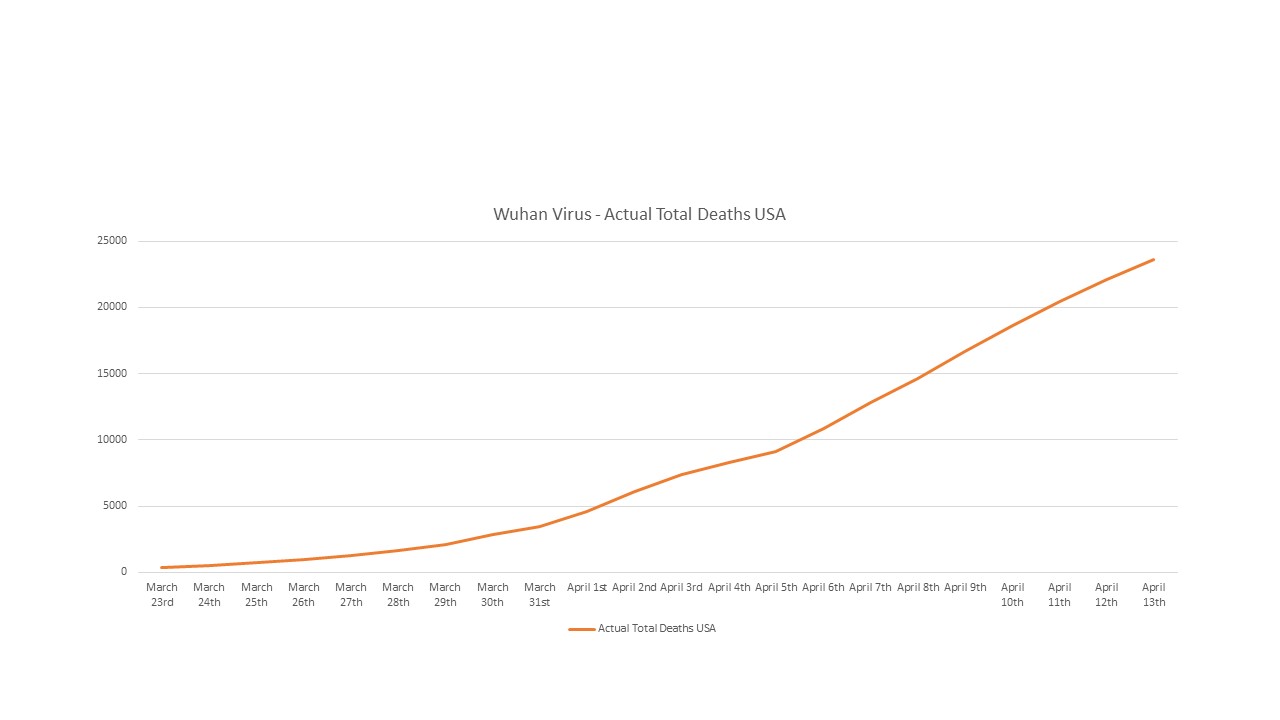


 21BanyanTree Life Coaching
You must be logged in to post a comment.