Is marriage necessary? One perspective

ॐ श्री मात्रे नमः (Photo by Soumik Dey on Unsplash)

By Jayant Kalawar, June 19th 2023

I was invited to participate in an online panel discussion on the institution of marriage in contemporary times that took place on April 17th 2023[i]. The panel discussion was moderated by Professors Dr Jayanti P. Sahoo[ii] and Dr. Aparna Dhir-Khandelwal[iii]. The moderators focused on how women’s roles have changed in contemporary times through their work in business, professions and academia. They contrasted these changing roles with an overall lack of change in roles in marriage, where women continue to shoulder disproportionate responsibility in carrying out child nurturing and household maintenance activities. If marriage is to be an equal partnership among spouses in what they contribute into the marriage, then it seems that modern women are getting the short end of the stick.

In this post I am exploring a big picture approach on how to think of the institution of marriage using selected principles from Hindu ShastrAs (from darshanas and agamas). I hope to inquire (this post is just a beginning) how such principles may help in understanding different frameworks for marriage that have emerged in different parts of the world, at different times over many millennia[iv].

I am making this exploration of how  the explanatory power of concepts from Hindu ShastrAs can help us understand changes in core human social organization, household and marriage, that we are witnessing in recent times. I hope to describe what I see through the lens I am constructing. Not to prescribe, not to moralize. The aim is to open up thoughtful conversations on the practical matter of marriage as a social institution, using a lens constructed from Hindu ShAstrAs. Conversations which do not devolve rapidly into prescriptive sermonizing and hopefully instead open up more than one intellectual spring from the deep and broad glacial wisdom of Hindu ShAstrAs.

I am somewhat familiar with social and cultural flows in India and the USA. So the examples of a range of forms of marriage I present, in the course of my exploratory inquiry here, are from these two countries.

For example, in India there currently (in 2023) are three different recognized legal frameworks for marriage: Muslim Personal Law (1937), Special Marriage Act (1954) and Hindu Marriage Act (1955). The emergence of these three laws of marriage over the last hundred years reflects the reality of multiple streams of Indian cultural and social histories converging in the modern Indian nation-state. In March of 2023, the Supreme Court in India took up the matter of whether marriage between individuals of same sex would be legal under the Special Marriage Act. This may be seen as a reflection of the currents of globalization crisscrossing India. Much of such currents emerge from the USA at the present time.

In the USA, institution of marriage has been contested in different ways. In the mid-19th century there was a contest between monogamy and polygamy when Utah was incorporated into the United States, with monogamy, as a result, becoming the established law across all states[v]. In the late 19th and early 20th century, social and legal status of women in USA changed, giving women property rights, followed by political rights of voting. In the mid to late 20th century opportunities opened up for women to work outside of home, to earn independent incomes, especially post World War II. Through these steps women gained autonomy, which then reflected in changes in the form of the monogamous marriage. Divorce laws emerged in different states, along with child custody and community property related legislations[vi]. Marriage in practice became dependent on continuing agreement between two adults of opposite sex  to co-habit, have and nurture children. Marriage thus became subject to continued agreement between the two adults and resulted in no-fault divorce legislations emerging in the late 1960s and early 1970s. In  late 20th to early 21st century question began being raised whether two individuals same sex can get married. Same-sex marriage was ruled to be legal in 2015 by the US Supreme Court.[vii]

So what drives different human communities to develop different norms for the institution of marriage at different times? I am not presenting a ground up cultural anthropology perspective[viii]. I am presenting a top down first principles based perspective from within Hindu ShAstrAs. My hope is  to re-discover explanatory power of Hindu ShAstrAs to address seemingly complex questions that humans face, such as how the institution of marriage undergoes change depending on desh-kAl-paristhiti.

Some Selected Concepts From Hindu ShAstrAs

Here are a few concepts from my understanding of Hindu SHAstrAs that I will bring into play in this initial exploration into the institution of marriage.

One is the concept of svAtantrya, freedom, autonomy, as articulated in the PratibhijnA branch of Advaita by AchArya UtpaladevA, Somananda and Abhinavagupta in the 10th and 11th century CE. This is a shruti concept articulated by rishis.

A second concept is that of LeelA, the myriad dynamic manifestations of the Devi. LeelA is playful expression of desires, the acting out of svAtantrya.

SvAtantrya and LeelA may be seen as seamless process concepts to describe the principle of sat-chit-ananda-iccha-jnana-kriya.

A third subsequent concept is a particular manifestation of LeelA as Manav Jati, with the desire to sustain and grow it. How is the Manav JAti to sustain and grow? As a response to this desire of the Devi Hindu ShAstrAs propound AshramAs of a life cycle of the human physical body, with grihasta AshramA being the central phase in a human life span. As we know, this has been spoken of in smritis and dharma sutrAs, constructed by Shastrajna’s based on empirical observations of different roles played by humans in different phases of their life cycle in the context of specific desh-kAla-paristhti.

I propose that we understand these concepts by viewing the human in a sharira-traya frame of sthula-sukshma-karana sharira.

SvAtantrya is the essence of freedom expressed by ShAkti and drives myriad manifestations reflecting playful desires of Shiva-Shakti. In the individual human, this Svantantrya principle manifests as AhamkArA. The desires of AhamkArA play out at as individuality at the level of Sukshma sharira through the Jnanendriyas. In turn, the desires of the AhamkArA are channeled as actions by the JanendriyAs through KarmendriyAs in every day interactions with other humans and the in the natural environment – with the intention of satisfying desires. The five tatwas, essences, that undergird SvAtantrya are chit-Ananda-iccha-jnana-kriya[ix].

Manifestation of SvAtantrya as human species on Earth: through the play of the Devi’s Iccha-Jnana-Kriya shaktis the five bhuaktika tatwas arise: earth-water-fire-air and sky. In parallel, arise jnanendriyas and karmendriyas. One such configuration of jnanendriyas and karmendriyas when it interact with the earth-water-fire-air-sky manifests as the human species. One of the Icchas of the human species so manifested is to sustain and grow itself. That leads to the play of grihasta AshramA, the householder.

The concept of grihasta AshramA has been central to procreation and sustenance of the physical body, the sthula sharira, of the human species. The sustenance of the sthula sharira of the human species is an expression of the playful desire of Shakti to enjoy the panch tan mAtrAs. While svatantrya concept promotes individuality in humans, the grihasta Ashrama concept promotes cooperation and collaboration, to enable sustenance and growth of the species.

With this background I begin my exploration of the current state of the institution of marriage which is a core human social construct within the Devi’s LeelA, play, of grihasta Ashrama.

The two concepts of SvatantryA and Grihasta AshramA may be seen to be orthogonal to each other. When an individual human is fully committed to grihasta AshramA, let’s say a 100, the svatantrya principle is at zero. When svantantrya is at 100, grihasta ashrama is at zero.

The role of marriage in grihasta ashrama being central, its form and unfolding in a social milieu will reflect the balance struck between the two principles. What drives such a balance between svatantra principle and the grihasta ashrama principle? I suggest it is a combination of the three sources of disturbances that humans experience as propounded in SAmkhyA: adibhauktika, adidaivika and adhyatmaka.

Adibhautika may be taken as socio-economic, often technology driven, and environmental flows in a society over which humans may have control over.

Adidaivika may be seen as great natural forces over which humans have no control over for example ice ages, many decades of droughts and consequent famines.

Adhyatmaka may be seen as the capacity to cognize and become aware of dynamic changes in adibhauktika and adidaivika. SAmkhya shows there is considerable scope of misapprehension of such experiences by humans. When such misapprehensions are multiplied over many humans, it results in sustained confusion. I suggest that this tendency towards confusion, arising due to limitations in the human cognitive process  as described in SAmkhyA, leads to loss of capacity to strike a balance between svantantra and grihasta Ashrama principles, when such balance is disturbed from Adibhauktika and Adidaivika sources. Human groups then work towards bringing balance back. As marriage is a core engine of balanced human flourishing, success of the re-balancing process of the form and dynamic of marriage becomes one of the drivers for sustaining and growing human groups.

So now let’s look at applying these concepts to get a sense of current state of marriage in the USA and India. First here is some high level background:

The Respect for Marriage Act (RMA) of 2022 passed by the US Congress made civil unions among any two human individuals legal. This not only allows two individuals of opposite genders to enter into a civil union, even if that is not recognized or sanctified by one or more religions, it also enables same sex partners to enter into legal civil unions. In turn, such same sex couples can legally adopt and raise children, just as opposite sex couples can.

The  RMA of 2022 also specifically made interracial marriages legal. Until 1960s, there were a number of states in USA that had laws declaring interracial marriages unlawful. The US Supreme Court ruled in 1967 that such state laws were unconstitutional. However, it was not until 2022 that US Congress positively recognized interracial marriages as legal.

The RMA also excludes civil unions  among more than two individuals, thus declaring polygamous unions continue to be illegal.

In India, as listed earlier there are three major laws governing marriage (as listed earlier). Under one of them, Muslim Personal Law(1937), polygamous marriage is legal, marriage is contractual and between individuals of opposite sex. Divorce is relatively easy. Property division is according to contract entered into at time of marriage. The Hindu Marriage Act (1955) enables marriage of two individuals of opposite sex. Divorce is not easy. Property matters are subject to laws governing Hindu joint families. The Special Marriage Act (1954) enables two consenting adults of opposite sex to enter into marriage. Divorce is possible. Property division can be contentious in case of divorce. Inheritance laws under each of these acts differ, reflecting custom and history of the constituent community that is supported by each act.

The current conversation among younger generations in India seems to be around live-in relationships[x]. Hearings by the Indian Supreme Court about legality of same sex marriage has also made for headlines in India recently (May 2023)[xi]. The Court directed that the Union Ministry of Law and Justice to have its Law Commission to seek views and ideas from civil and religious groups to develop a Uniform Civil Code (as of June 14th 2023) for marriages, divorces, child custody, property division and inheritance.

So how to explain the apparent difference in trajectory of the institution of marriage in the USA and India using the conceptual tools I have identified above?

A perspective on current state of the institution of marriage in the USA

Of the three sources of change (Adibhauktika, Adidaivika and Adhyatmika), American socio-economic frame responds to the Adibhauktika the most (changes to human made material technology and social constructs). It secondarily focuses on changes in Adidaivika (large scale natural events such as hurricanes, floods, droughts, wild fires). Relatively, it focuses least on Adhyatmika (the self-aware cognitive process, which in humans is prone to mis-apprehension as SAmkhyA elegantly articulates). The technologies it has developed leads to enabling svantantrya, individuality / autonomy (and to remind ourselves, svantantrya in humans manifests as ahamkAra). As individuals are more able to sustain themselves with less cooperation and collaboration with other individuals, the need for households decreases. So if over all economic and health wellbeing of the individual is less dependent on group collaboration, then size of households is likely to decrease, including rise of single households. We see that happening in the USA.  Along with this, as reproductive technology gains traction (freezing eggs and semen, in-vitro fertilization, surrogate pregnancies and more), the need for marriage may change and along with that its form. In other words, if the desire to sustain and grow the human species can be satisfied utilizing technologies that require less collaboration and cooperation, social constructs of households and marriages may change to adapt so that individuals can express their individuality more.

Recent US history supports such analysis. The combination of two factors stand out vis a vis the svAtantrya principle. One is women in the work force outside of the home beginning with industrialization and accelerating in late 1940s, after World War 2. The second is technology to manage reproductive process. As a combination of these two factors, the svAntantrya principle has acquired higher value in recent decades relative to previous socio-economic-technology epochs. In turn, it has promoted individuality, thus leading to challenge to structure of grihastashrama in general and marriage in particular. Thus single parent household, as well marriage of same sex partners, may be seen as a viable option to raise children.

A perspective on the current state of the institution of marriage in India

Of the three streams of marriage frames that currently flow in parallel in India (Hindu Marriages Act (1955), Special Marriages Act (1954) and Muslim Personal Law (1937), I have some familiarity of the Hindu Marriages Act.

 The Hindu Marriages Act in India is based on traditional norms practiced by Hindus over many millennia, with some changes to suit the current paristhiti as perceived in mid-20th century: marriageable age for females was set at 16 (previously in many Hindu communities the practice was marriageable age for females to be at puberty, which could mean age as low as 9 in some cases). Another change was to uniformly enforce monogamy (previously some Hindu communities practiced males having two wives under certain circumstances). The inheritance laws of the unified Hindu joint family were carried forward, especially for example the male child’s mother and sisters having claim over inheritance along with the widow. Rules for division of property in case of divorce is also not clearly defined ,as divorce was assumed to be an exception than the rule.

The norms of Hindu marriage and accompanying grihastashrama (householder) roles in Hindu joint families were practiced by learning them through repetitive performance of specific rituals. As one illustrative example, the ritual of Gauri Puja (also called Hartalika in northern India) in Karnataka teaches how the wife goes to her mother’s house due to a tiff with her husband. The son is sent to persuade her to come back home, in the process showing great respect and admiration for his mother and the husband for his wife. The rituals are still performed, but the desh-kAl-paristhiti has changed. Such practices have now become more performative and less learning and action paradigms that may have been the original intention.

As the gusts of technology and finance driven globalization course through Indian socio-economic and cultural framework, one key outcome has been increase in sense of svAntantrya, especially economic freedom, among a fair number of Hindu women, especially in urban areas. Those gusts of globalization are Adibhauktika. They are to be expected. Resilience in the face of these gusts is to sharpen Adhyatmika, to go back to first principles and redesign norms in context of desh-kAl-paristhiti. Not through doubling down on norms designed and articulated in specific desh-kAl-paristhiti about 2500 years ago.

In my estimation, at present stage of my self-study and research, Hindu ShAstrAs have the capacity to not only explain the challenges that the frames of marriage and householder (grihastashrama) may be currently facing in India. They can also provide guidance on how to redesign these social frames so that they are more resilient to and enduring in the face of the current technological and financial forces that are at play. It opens up the possibility to do so in a  transparent manner with critical thinking based on philosophical principles, that can involve youth in the conversations in collaborating in the redesign.

Edge Cases

Let’s take up some edge cases to test the explanatory power of the beginnings of the philosophical conceptual framework I am positing. For, it is the edge cases that challenge the mainstream core. When we recognize the edge cases as an integral part of Devi’s LeelA, then we can begin to gain an understanding of how the edge cases can co-exist with the mainstream core. The nucleus of a human cell is where all the action may take place within the cell. But its sustainability and capacity to multiply depends on how secure the cell borders are. For social constructs such as the institution of marriage, those borders, I posit, are the edge cases.

The edge cases I will very briefly take up here, in the context of the institution of marriage are: of widows, widowers, divorcees, single parents as well as individuals who do not fit neatly into the binary of male and female categories. For purposes of this already long post I will set up questions for each of these edge cases, which may open doors to further inquiry in subsequent writings.

Are widowers better able to form new households or expand their existing households as they have better income and asset potential in the USA? Are they better able to do so among Hindus due to inheritance laws and relatively higher social status? Conceptually, the economic leg up gives more svAtantrya, the play of ahamkara.

Do widows, especially relatively younger ones, face more challenges to sustain their household roles due to relatively lower income and asset levels in the USA (which may have improved in the last few decades)? Are inheritance laws and social status concerns a challenge to Hindu widows? As global technology and financial changes give Hindu women more capacity to act on their svantantrya, will they challenge current Hindu grihastAshrama, household and its core building block, marriage along with inheritance norms?

Similar questions can be raised for the divorcee edge case, for males and females. As Adibhauktika changes manifest as socio-economic theater, the scripts for various roles of the humans play in the LeelA of sustaining and growing a flourishing human species on Earth will change. Does the svAntantrya principle seem to have a feedback loop in the Adibhauktika theater manifestation – to enable more play? Is this something that manifests through roles of human females?

The edge case of single parent household begins to bring the question of whether and how human children can be nurtured to healthy flourishing adults outside of marriage. Can humans begin to cognize nurturing and raising children as a separate function from conceiving and birthing them? Can we consider emergence of a social organization (the notion of the state), with supporting technology and finance, driven by the human svatantrya impulse for individuality and autonomy as Adibhauktika? Perhaps whether the single parent household will grow depends upon whether the twin IcchA, the desires of the Devi, of individual svantantrya and of sustaining and growing human species on the other, are satisfied? If through social organization of technology and finance these twin desires are met, will it make marriage an optional way of conceiving, birthing and nurturing children to adulthood?

The questions raised in context of single parent household sets us up to inquire about the last edge case we will consider here. Can two individuals of same sex live together and nurture children to healthy flourishing adulthood? If so, would that be considered marriage?

The questions posed in the context of the edge cases require research and discussion. That in turn may lead to better understanding of how grihastashrama, households, and marriage as a core central institution may evolve with changes in Adibhauktika and Adidaivika.

My takeaways from this post

The twin Indic philosophical concepts of Svantantrya and LeelA may enable one to deconstruct the institution of marriage and household (grihastashrama) for the current desh-kAla-paristhiti in two different social milieus, USA and India. There may be potential to do so without having to depend solely on authority of what the practices and institutional designs were 2500 years ago when the desh-kAla-paristhiti were very different. That tells me that Hindu ShAstra concepts have the explanatory power that humans seek so that they can construct social organizations in consonance with Adibhauktika and Adidaivika. My sense is that such explanatory power arises due to concepts Hindu ShAstrAs being deeply rooted insights from AdhyAtmika perspective of Rishis.

So where do we go from here? I see opportunity for practical redesign conversations among Hindu constituents using concepts from the Hindu ShAstrAs so that, for example, the Hindu Marriages Act can be amended to reflect current desh-Kal-paristhiti while retaining the Adhyatmika guidance from our Rishis, without having to depend (especially as sole authority) on Adibhauktika designs from 2500 years ago tailored for those times and places. In other words, we may have an opportunity here, through extended tapas, to rejuvenate multiple intellectual springs from the deep and broad glacial wisdom of the Hindu ShAstrAs, so that the springs come down to the plains of desh-kAl-paristhiti to nourish us all.


[i] Video of the panel discussion has been made available here: https://www.vyoumtube.com/v/ma8XDvZHo8C

[ii] Dr Jayanti P. Sahoo is Associate Professor, Department of Philosophy, Janki Devi Memorial College, University of Delhi.

[iii] Dr Aparna Dhir-Khandelwal is Assistant Professor at the School of Indic Studies, Institute of Advanced Sciences, University of Massachusetts, Dartmouth.

[iv] Over the at least the last 2500 years or so human households (group of humans identifying as a family, with different roles to support each other is how I see households) provide the platform for us to play out our life cycle, from conception, birth, nurturing, adulthood and old age. They were and are a key to inter-generational human flourishing. Marriage was and is the core foundational block in such human households. Human groups across time and geography have come up with different ways of forming households. This is in turn reflected in different forms of marriage.

In the last hundred years or so, the emergence of the welfare state (consequent to emergence of the nation-state in Europe post the Enlightenment) in tandem with technology and financial organization, has offered a number of support functions that households provided in the past to the process of raising children to be healthy and flourishing adults. In turn, the form and function of households and marriage has undergone change.

[v] https://www.mtsu.edu/first-amendment/article/1040/morrill-anti-bigamy-act-of-1862#:~:text=Morrill%20Anti%2Dbigamy%20Act%20of%201862%20(1862)&text=%2C%20R%2DVt.-,The%20act%20was%20passed%20in%20response%20to%20the%20perceived%20threat,Saints%20(Mormons)%20in%20Utah.

[vi] https://historycooperative.org/the-history-of-divorce-law-in-the-usa/

[vii] https://www.npr.org/sections/thetwo-way/2015/06/26/417717613/supreme-court-rules-all-states-must-allow-same-sex-marriages “As the Supreme Court’s summary states, “The history of marriage is one of both continuity and change.”” “The ancient origins of marriage confirm its centrality, but it has not stood in isolation from developments in law and society,” Kennedy wrote. His opinion sketches a history of how ideas of marriage have evolved along with the changing roles and legal status of women.

Comparing that evolution to society’s views of gays and lesbians, Kennedy noted that for years, “a truthful declaration by same-sex couples of what was in their hearts had to remain unspoken.”

[viii] For cultural anthropology perspective, I would suggest David Graeber’s book, which questions mainstream western anthropology: https://www.amazon.com/Dawn-Everything-New-History-Humanity/dp/0374157359

[ix] Getting a working sense of these 5 tatwas is possible through upasana, being connected with the Devi, under the guidance of an AchAryA.

[x] https://mahabahu.com/live-in-relationships-gain-acceptance-in-india-a-cultural-shift/

[xi] https://indianexpress.com/article/explained/explained-law/sc-same-sex-marriage-here-are-the-arguments-over-10-days-8609177/

What is the best use of time in our lives?

Kaal Bhairavi Source: https://en.wikipedia.org/wiki/Bhairavi

KAl Bhairavi Source: https://en.wikipedia.org/wiki/Bhairavi

By Jayant Kalawar, June 11th 2023

It depends. On phase of life cycle. On particular circumstances at a given time and so on. Desh-kAl-paristhiti.

That said, there is a way to expand the sense of time to live a more fulfilling life.

Living in the world of senses makes us seek sense gratification through pleasures. Sense pleasures are transitory. The demand for seeking out different ways of gratifying the senses keeps increasing. Time passes quickly in pursuit of sense pleasures.

Living in the world of buddhi, the intellect, slows down time. ShravaNa (interpret as study here) and manana (contemplation, through writing, repetitive performing) can help here. Study and writing slow down time, as your attention gets focused. Same happens with learning and performing music, dance, painting, sculpting. Focused attention slows down time, enabling the physical and emotional body a better chance to be in rhythm with its natural environment.

Living more and more in dhAraNA and dhyAnA slows down time even further. It expands the possibilities of living a more fulfilling life.

Hope some of you, after reading this you have curiosity to ask how to do this. That curiosity will make you a mumukshu, a seeker.

Are the Mists Clearing in 2021?: A Brief Look from Jyotish Perspective

The Destroyer of Ignorance and Confusion – Aum Namo KAlarAtreya NamAhA (Source: Wikipedia, Devi Kalratri, Sanghasri, Kalighat, Kolkata, 2010)

By Jayant Kalawar, January 4th 2021

From Jyotish perspective, December 31st is an arbitrary date to end one phase and begin another. But then we are living in the Anthropocene age, disconnected and alienated from the great planetary energies that are coursing through us and all around us. We are lost in the ignorance of our disconnections.

So, we will pause for a bit on this January 4th 2021 and take a brief look at where we are. I am speaking of the USA here, which is where I am based.

First let’s look at what is happening with Covid-19 pandemic. It seems to be tracking pretty much along the lines of what I had predicted in my post of April 22nd 2020: second wave to begin mid October 2020, peak in December 2020 and recede beginning February 2021. It may be somewhat more impactful than the first wave of spring-summer 2020, it will be nowhere near the extreme death laden second wave of the Spanish flu of the Fall of 1918.

In that article I also predicted that there may likely be no third wave of Covid-19 in the spring-summer of 2021 (unlike the 3rd wave of the Spanish Flu in the spring-summer of 1919). With vaccines being administered, it would seem that the third leg of the pandemic may be subdued, if at all.

Here is the link to the article, to those who want to revisit: https://21banyantree.com/2020/04/22/3-waves-of-spanish-flu-of-1918-1919-can-we-expect-a-repeat-now-a-jyotish-perspective/

When you go back and read the article you will notice that I had put a caveat: “IF at all there is a second wave….”. The reason for such caveats is two fold:

– Personally I do not wish to predict potential for deeply negative futures using Jyotish modeling tools.

– When I do, I do so in context of what can be done to overcome or surmount such negative scenarios. This is possible with individuals who are open to counseling, not for large social groups.

The rationale for making the prediction of the pandemic waves was to document the power of Jyotish in making such predictions involving complex social processes. And in this case, I think it may be seen to be perhaps better than other prediction models that have been used to predict the breadth and depth of pandemic waves in 2020-2021.

So that was about Covid-19, the pandemic caused by the virus which is said to have originated from Wuhan, China.

—————————————-

The other aspect I will briefly touch on in this post is the political situation in the USA as I write and post this on January 4th 2021.

I had predicted that Trump may win on November 3rd 2020. I had based it on his birth chart (based on a birth certificate), when compared to Biden’s (tentative, his birth date / time are available only from memory of relatives, not on a birth certificate). That has not turned out to be a correct prediction. If December 14th was taken as the decisive election date (when electoral certifications were finalized), his chart predicts a most severe set-back. And that is indeed what happened.

Meanwhile, USA is going through a transformative Ketu sub-period spanning December 10th 2020 to about mid April 2021. The Ketu property of unexpected separativeness in current structures may likely to course through public institutions of the USA during this period. The mists will clear after April 15th 2021. I have begun writing drafts in more detail about modeling USA political history from a Jyotish perspective, but that will take time to think through and then present in ways that make sense for non-astrologers. So, I decided in the meanwhile I should post this short term view today to give some pointers for the next few months.

So, in summary, the pandemic situation in USA may seem to be pretty much in control after early February 2021. The political climate in USA may likely begin stabilizing after mid-April 2021.

Focusing Inward in these Covid-19 days

Sri Gayatri MAtA by Raja Ravi Verma Source Wikipedia

ॐ श्री मात्रे नमः Source: Illustration by Raja Ravi Verma as published at https://en.wikipedia.org/wiki/Gayatri

Hot humid summer days open up opportunities for early morning walks. There are some days, though, when early morning hours are hot and humid and the body and the mind resist and find excuses to stay within air conditioned comfort.   In 2020, there are added reasons with Covid-19 and social distancing. In New Jersey, at the time of this writing in mid-July, it is generally accepted to be prudent and wear a mask or face covering even while out on a solitary walk, with runners and joggers, many young of age with  a sense of immortality, who may run past you breathing heavily.

On one such early hot and humid Thursday morning, instead of walking I found myself sitting in air-conditioned comfort in front of my laptop, logged into Zoom and waiting to be connected to an ongoing discourse on Suresvara Ācārya’s Naiṣkarmya Siddhi by Swami Shantanandaji[1].    Thursdays are Guruvāra, Guru’s day and a good day to listen and reflect on Vedanta teachings from Adi Shankaracharya.  While waiting for Swamiji to connect, I wondered what light would be shown to us through the discourse this morning.

Swami Shantanandaji is no more than 2 miles from where I am sitting and, in these Covid 19 days, we connect only online for the early morning discourse. This Thursday, Swamiji expanded on two key terms: cidābhāṣa and vṛtti which while not new in my many decades of study of Vedanta, are quite elusive to grasp and immerse and revel in for their full import. In the process of writing this post I am hoping to root these subtle concepts a bit deeper in myself.

Cidābhāṣa points at once to the human capacity to be self-aware (cit) and to the ability to experience a limited structured world (bhāṣa). For instance, I have the capacity to say “I am” to myself and, going further, I can also sense my own presence without using any language. That is what happens in my meditation seat: as I focus inwards, languaging drops away and, with it, thoughts disappear. There are moments when I only have a sense of being present. This sense of being present, without any thoughts, is cit, the capacity to be self-aware, presenting itself. 

Such a sense of presence is momentary, fleeting, for me.  Because, in the very next moment, the body intrudes and signals that it is thirsty or  hungry. And like a mother reaching out to a child, this capacity of cit, to be aware, flows out to be entangled  between solving the problem of overcoming the thirst or hunger and negotiation of the urgency of these signals with reveling in and extending the moments of being self-aware in meditation. In this moment, Cit energy (Cit śakti) flows away into the body and only the body and its particular problems exist. There is a limited sense (bhāṣa) that arises for those moments, that the body is all that exists and this limitation is false. But in that flow of Cit to the body, in these moments, the capacity to even explore the possibility that I am not limited to the body is not available.

The possibility of limitlessness, that I am not limited to my body, is what I am not capable of fully immersing, like water to a fish. The fish does not have knowledge of the vastness of the waters it is in; it may not even be aware that it is in something like water. The fish is an extension, and integral part, of the water ecosystem (before I do the ‘so also’ let me say I am alert to the limitations of this ‘fish in the water’ metaphor and use it only to help visualize what I share next).  Like the fish, the human lives in an ocean, one of cosmic vibration which manifests itself as Cit śakti in the human body. In the process of manifestation, the property of connection with the ocean appears to be lost. So, Cit śakti gives us the capacity to be self-aware and also be aware, in a limited way, of the human body in which it manifests. But this dynamic awareness enabling energy, Cit śakti, that manifests does not allow for an easy connection back to its source, the ocean of cosmic vibrations.

What is this ocean of cosmic vibrations? One way is to describe it in terms of its properties: Sat-Cit-Ānanda. Sat is the property of being always and everywhere. One of the properties of satcitānanda is manifestation outside of space and time; it is not bound by space and time. We can, however, begin to sense its presence through certain of its properties. Just as we can sense the presence of water in the ocean, through its properties of wetness and its liquid flow, so also, can we sense the presence of Satcitānanda through two of its properties: the property of self-awareness, which is Cit, and the property of contentment, which is Ānanda. Our awareness capacity, Cit, is limited. We experience sukha (happiness) and duḥkha (sorrow),  but rarely contentment, Ānanda. And because we are bound by space and time – we are a-sat (not sat). Here, in my meditation seat, in my own little personal reservoir of awareness, cit, is fed by a trickle from satcitānanda, but I cannot sense that connection. How do I get to this place, where I can begin to sense a connection with satcitānanda and, then, actually connect? This is where mokṣa śāstra comes into play, and to have a Guru guide you through the systemized process (śāstra) to connect with and immerse (mokṣa) in satcitānanda.

This is a good place to ask: what keeps us from beginning to focus our energies to seek this connection to Satcitānanda? Because of Vṛtti.

Vṛtti, the other keyword Swami Shantanandaji raised in his discourse that summer Thursday morning, is disturbance; a disturbance that causes ripples or a storm in the tranquility of the reservoir of Cit śakti in us. Much of the time, most of us have a disturbed Cit śakti.

The key Vṛtti generating factors are our desires to play in this material world. And at this particular period on Earth, in 2020, we have a pandemic triggering particular desires: to survive now and to continue to do so in the longer run, while we consume an overload of information on  how to survive. Much, if not all, of our Cit śakti is spent on this so we can take precautions to be safe and healthy while anxiously worrying about our financial future. The opportunity, even momentarily,  to use some of our Cit śakti to recall and reconnect with the Satcitānanda, is near zero. Unless, and this is a Big Unless, we are blessed with the opportunity to be in satsang with ācāryas who tirelessly and with complete focus, because of their sustained focus on Satcitānanda,  we are effortlessly guided to re-focus on our interior self. That is what happens every time I have the opportunity to attend Swami Shantanandaji’s discourse on these Thursday mornings.

I will hazard a guess that the pandemic has helped many of us focus on a few things. In fact, in pre-pandemic times, many who may have been continually distracted pursuing the narrative of materialist modernity which shaped almost every waking moment of our lives, and in our dream are beginning to avail of the opportunity to seek satsang and become aware of ourselves.[2]

Ācāryas in the past have spoken of many veils that cloud our view of Satcitānanda.  What materialist modernity has constructed over the past 400 years is not a veil but a reinforced fortress wall. Any attempt to scale this wall and turn inward is met with ignorance, since the language of modernity does not have embedded within guidance on Satcitānanda. Any sensibility that is not a part of the modern narrative is denigrated and without guidance to search inward, we are pulled relentlessly, by modern logic, narrative and theories, to find happiness by continually playing win-lose games in the material world of our senses and keep us engaged in this material endeavor.

In this context, I see Covid-19 as an opportunity to turn inward and find satsang, as these distractions have been temporarily brought to a standstill, to guide us to dismantle brick by brick, the wall that modernity has erected within us. That is what Advaita Vedānta can do: gently help deconstruct the modern logic and narrative that is holding us prisoner.

May many of us find our satsang soon. And at that satsang, may we find an Ācārya to begin guiding us to focus our Cit śakti, to begin connecting to Satcitānanda.

And just to close the loop, next time I go for a morning walk and a young person barrels down past me without a mask, I hope to be less fearful as I meditate on this connection, while taking precautions myself. I will think positive thoughts for the young runners and wish them well.


[1] Swami Shantanandaji is President of Chinmaya Mission West and resident Ācārya of Chinmaya Vrindavan, Cranbury, New Jersey.

[2] I have expanded upon this theme of the impact of modernity on human species in my essay: https://www.amazon.com/OUTSIDER-DECONSTRUCTING-EUROPEAN-ENLIGHTENMENT-Death-ebook/dp/B07RHVRV7V

Jyotish Covid-19 Pandemic Model for USA: Update July 12th 2020

Devi Cover for Outsider European Enlightenment Kindle 190506

WIth the Devi’s Blessings. Cover art by Jayant Kalawar 2018.

I posted a tentative Jyotish based model to predict and track the Covid-19 Pandemic in the USA on April 6th 2020. I titled it the memetic pandemic. I wanted to convey that the pandemic that we were experiencing was not only at the biological level of the virus. It was also at the mental level of language – in terms of incessant flow of torrents of information of the disease and its manifestation in deaths around the globe.

I ended that post with the following summary prediction:

So, what I would be looking for is whether the actuals begin to slope downwards as per prediction based on my Jyotish based model, between April 18th and April 25th and then slope downwards even further after between April 25th – May 2nd and accelerate downwards between May 2nd – May 9th. And whether total number of deaths stabilize around April 25th on wards. Let’s see.

Here is a representation of numbers of daily new deaths:

Actual Covid 19 New Deaths Weekly Feb - Jul 2020


What I see, in the chart above, is that the number of new deaths (7 day moving average for the United States) did peak somewhere between April 15th and 20th and then began to decline around April 25th 2020. as predicted. And, again on track with the prediction, the numbers began to go down sharply in the week of May 2nd. My model predicted up to May 9th.The model did pretty good in terms of predicting the slopes back in the April – May 2020 time frame. Not too bad for a first time Jyotish based model for a complex phenomenon of Covid 19 pandemic.

For Jyotishis, here is a brief description of how I arrived at the slopes (i.e. change in level of new deaths). I used a combination of 8th Lord (both natal and transit) aspect and 8th House placement on both transit and natal planets. In the case of USA SAMVA chart[1], the 8th Lord is Saturn and the 8th House is Aquarius, along with natal and transit Rahu / Ketu aspect on natal and transit planets.

Symbolically the function may be represented as:

Change in Level of New Deaths = f(f(8th L (NandTr), X), f(8th H, X), f(Ra/Ke(NandTr), X))

Where L=Lord, Tr=Transit, H=House, N=natal, Tr=Transit, X=any planet Mars, Moon, Sun, Sun, Mercury, Venus, Jupiter, Saturn.

The potential for change in level of new deaths is measured in degrees of separation of planet X from the 8th and / or Rahu / Ketu.

My sense is that I have been able to at least directionally predict a complex biological-social phenomenon in the USA, which epidemiologists and other experts have been trying to get their arms around. With such a directional prediction, I was able to say to myself and my family and friends that with proper safety precautions the pandemic is likely to decrease in its lethality by mid-May. This helped in managing down the level of anxiety and therefore have better sense of hope and well-being. I am also somewhat more encouraged now that there is potential to use Jyotish based models to predict large scale complex social phenomena. Of course, there will have to be many, many trial and error iterations before the Jyotish approach of large scale social phenomena begins to be helpful in designing prevention and mitigation strategies as appropriate.

But then what about predictions for after mid-May 2020? After all, the pandemic phenomena is still continuing as I write this on July 7th 2020.

Well, I extended my prediction on April 22nd to cover the time period between mid-May and late July by saying:

There is a chance that there may be a mild second wave of Wuhan Virus in USA during this period of mid May 2020 to end July 2020, which may be seen as a continuance of the current wave. The indicators point to more of a chance of potential for civil and political disharmony and economic hardship in USA in May and June 2020, but that is from a different set of planetary drivers, which I may cover in a separate post (in this post I am focusing on the pandemic concerns).

As you would notice, the prediction of civil and political disharmony and economic hardship in USA in the May – June 2020 time frame was quite accurate (beginning with protests after the death in police custody of George Floyd on May 25th 2020 and peaking out in the second half of June).

Before I go on to give you my predictions for USA for rest of 2020, there is one key point I would like to make – why did I title my first post on this Covid 19 pandemic, as a memetic pandemic? : the above model representation focuses on predicting sickness (driven by 6th H and 6th L Jupiter) and death (driven by 8th H and 8th L Saturn). How the information about such sickness and death (and also communal disharmony – affliction of 4th H and 4th L Venus), I governed by strength of 3rd H and 3rd L Mercury.

So, I was pointing to how memetic pandemics overlay biological pandemics: when tr Mercury was transiting through 8th H from January 30th to April 7th (and then from April 7th to May 8th through its debilitation sign in Pisces followed by  Aries afflicted by tr Ketu and natal Rahu), the media (both main stream and social) were continually channeling information about deaths from Covid-19. Then there was a very brief respite between May 8th and May 24th, when there was at least some neutral to positive news as Mercury transited through Taurus pretty strong and without affliction. Then on May 25th it transited into the 12th H of the USA SAMVA chart (Gemini) and its been there since, as of this writing in the first half of July. The media began reporting potential for losses, which is the hallmark of 12th H. It has kept stressing how new cases of Covid-19 are rising. But it did not convert to either hospitals being filled up, nor to sharp increases in deaths, which are to be expected as new cases rise (according to expert epidemiologists). I was able to confidently predict that this would not be so, that there may be a sense of a mild extension of the first wave up to the end of July. Hospitals did not fill up as tr Jupiter was no longer afflicted by Saturn since second week of May and moved back into its safe house Sagittarius in early July. Deaths did not rise because tr Saturn was no longer afflicted nor afflicting tr Jupiter or any other tr / natal planet or houses in the USA SAMVA chart. This has again helped me and my family and friends to manage anxieties down and have more of a sense of control. Learning and practicing the Systems Approach to Vedic Astrology (SATVA) over the last 14 years or so has really begun to pay off.  I would encourage more and more folks to invest time and effort to learn and practice SATVA[2].

Well, if you have read through here and you reading this in July 2020, this may find this useful for you to navigate the next 6 to 8 months.

So here are my predictions for the rest of 2020:

US economy will see an upswing from July to early November (tr Jupiter in its own house Sagittarius).

The political and community scene in the US will be divisive (which may as may be expected in an election year 2020) between mid-July and early November (tr Jupiter aspects natal Venus).

From November 5th 2020 to early February 2021 there may be rise in sickness / deaths and intensity of civil and economic disharmony, as tr Jupiter and tr Saturn come into close conjunction, while the nodal axis stations at approximately 26 deg in exaltation in Taurus and Scorpio.

So, that’s it for now. Stay safe, enjoy and take care.

[1] https://cosmologer.blogspot.com/2007/12/samva-usa-chart.html

[2] http://yournetastrologer.com/difference.htm

3 Waves of Spanish Flu of 1918-1919: Can we expect a repeat now? A Jyotish Perspective

Devi Kalaratri source Wikipedia 180808

The Destroyer of Ignorance and Confusion – Aum Namo KAlarAtreya NamAhA (Source: Wikipedia, Devi Kalratri, Sanghasri, Kalighat, Kolkata, 2010)

Background to this post

As I was observing how actuals for the current (April 2020) Wuhan Virus pandemic in USA were tracking quite well to the slope (not the levels) in the graphics produced by my Jyotish based model (posted on April 6th), I received a suggestion[i] that it may be helpful to assess what Jyotish factors drove the Spanish Flu pandemic of 1918 – 1919 in USA.

So in this post I am looking at how the planetary patterns played out in the three waves of the 1918-1919 pandemic in USA. I then compare the 1918-1919 planetary patterns to the planetary patterns that will be in play between now and summer of 2021, using the Systems Approach to Mundane Vedic Astrology[ii]. The conclusion, which you can read in more detail towards the end, is that there appears to be a potential for two waves of the Wuhan Virus to arise in the USA:

Jyotish indicators show that there is some potential for what may be a mild second wave of Wuhan Virus in USA during mid May 2020 to end July 2020. This second wave may be seen as a continuance of the current wave (as I write this in mid-April 2020). There is more of a potential for civil and political disharmony and economic hardship in USA in May and June 2020, but that is from a different set of planetary drivers, which I may cover in a separate post (in this post I am focusing on the pandemic concerns).

There are indications of a third wave of Wuhan Virus arising between mid-October 2020 and February 2021, with a peak in December 2020 (which happens to coincide with the typical seasonal flu period in USA, beginning with spread of contagion from the Thanksgiving Holiday, through to Christmas Holidays and the New Year). My analysis based on Systems Approach Jyotish indicates that if at all such a third Wuhan Virus pandemic wave arises in the Fall of 2020, it will not be anywhere near the severity of the devastating wave of the Fall of 1918 pandemic.

Many of you may find it helpful to use these broad predictions (with probabilities) to develop scenarios for your business and your personal lives. Keep in mind that even these threatening scenarios can be made into opportunities if applied keeping individual business and personal specifics in context and with safety in mind.

You can read more about the Spanish Flu Pandemic in USA of 1918-1919 in this article by the Center for Disease Control (USA)[iii]. I will focus on the three waves of the deadly pandemic in Spring of 1918, Fall of 1918 and Spring of 1919.

Pandemic of 1918 Three Waves

So in order to develop a meaningful understanding of the planetary patterns for the 1918 – 1919 pandemic in USA, I begin with noticing the following in the USA SAMVA 20 degree Cancer rising chart[iv]:

For 1918-1919 the USA chart shows a Rahu major period with a Rahu sub-period covering all three waves. Rahu is the north node created by intersection of the Moon with the Sun. The disturbed energy pattern created by the Moon-Sun intersections become fertile space-time areas for disease and deception.

Now let’s look at the transit configurations of:

  1. Where the nodal axis (Rahu / Ketu) was stationed during each of the three 19189-1919 pandemic waves.
  2. Where Jupiter, the ruler of the 6th House in the USA chart and which has potential to trigger disease, was transiting during each of these three waves of 1918-1919.
  3. Where Saturn, the rules of the 8th House in the USA chart and which has the potential to trigger death and death like experiences and raise obstructions to attempts towards resolution, was transitioning during each of these three pandemic waves.

First Pandemic Wave (Spring 1918) Transit Positions:

  1. Rahu was stationed at 29 deg in Scorpio, weak and debilitated in the 5th House of the USA chart, while Ketu was stationed at 29 deg in Taurus, debilitated in in the 11th House of the USA chart.
  2. Jupiter, the disease trigger for USA chart was transiting over tr Ketu at that time. It was not stationed over it. Nor was it impacting any of the critical points in the chart. It did trigger disease, but at a relatively low level in the first wave.
  3. Saturn, the giver of death and death like experiences in the USA chart (Saturn can be a positive force in most charts for most of the time. In the USA chart it has this negative potential as well) was stationing at near the ascendant point of the chart, in Cancer, during this time and impacted 7th house of faraway lands as well. It gave death like experiences not only due to the disease at home (1st house), but also in far away lands (WW 1 had ended, but death like experiences were continuing among those who had not yet returned back to USA at this time).

Second Pandemic Wave (Fall 1918) Positions:

  1. Rahu at 20 degrees Scorpio, debilitated and stationed on the most effective point and afflicting the Ascendant point with its 9th Ketu at 20 degrees Taurus, debilitated, stationed on the most effective point of 11th house.
  2. Jupiter at 20 deg Gemini, stationed on the most effective point of 12th House and afflicting most effective points of 4th, 6th and 8th
  3. Saturn at 5 degrees Leo, 2nd House, but not afflicting.

The combination of prolonged affliction of debilitated Rahu-Ketu to the ascendant and of Jupiter from 12th House of separation afflicting 6th House, may have triggered this deadliest of the three waves in the Spanish Flu pandemic.

Third Pandemic Wave (Summer 1919) Positions:

  1. Rahu at 11 degrees Scorpio, debilitated and stationed but not afflicting. Ketu at 11 degrees Taurus, debilitated and stationed but not afflicting.
  2. Jupiter was afflicted by 9th aspect of natal Ketu at 16 degrees in Gemini much of April and May.
  3. Saturn was afflicted by 10th aspect of natal Saturn at 26 degrees in Leo in the April – May time frame.

All three afflictions during the summer of 1919 were relatively mild. The relatively lower number of cases and deaths in the third wave reflect that.

My main take away from review of the three 1918 – 1919 Spanish Flu pandemic waves, through a Systems Approach Jyotish lens, is that combinations of direct affliction of and by the nodes and 6th and 8th rulers (in the case of the USA chart, Jupiter and Saturn) during a Rahu major / Rahu sub-period (the amplification by Rahu of the negativity introduced by the influenza virus played a major role back in 1918-1919 pandemic) and stationing of debilitated Rahu-Ketu, led to the immense death laden 2nd wave in the Fall of 1918, which took about half a million human lives in the USA in a few months.

So what does that mean for the Wuhan Virus Pandemic USA in 2020 – 2021?

Will there be repeat waves of Wuhan virus pandemic? Yes, I do see (from a Jyotish lens perspective) the potential for this to happen.

Will such repeat waves be substantially deadlier than the pandemic wave we are experiencing right now in April 2020? No, I do not see that to be so.

Here is why.

First, we note the major and sub-period in the SAMVA USA chart in the 2020-2021 period:

January 26th 2020 to November 30th 2020: Sun major period with Mercury sub-period. Both Sun and Mercury ensure positive benefits to the USA. Mercury plays a role in bringing communities together in mitigating negativities, including viruses.

December 1st 2020 to April 6th 2021: Sun major period with Ketu sub-period. This Ketu sub-period, channeling the disturbed energy of the intersection of the Moon with the Sun, could potentially provide the space-time area for a second wave of Wuhan Virus infection in the USA.

April 7th 2021 to April 8th 2022: Sun major period with Venus sub-period. Venus, along with Sun, provides positive benefits for the USA. A post-pandemic coming together of America (signified by Venus as fourth House ruler and also generally as signifier of prosperity), may be expected in this period.

To assess what chances there are for future waves of Wuhan Virus pandemic in 2020 – 2021, we will examine the next three Rahu-Ketu stations between now (April 2020) and the summer of 2021.

First Rahu-Ketu stationing from mid May 2020 to July 31st 2020

Rahu stationing at 5 degrees in 12th House Gemini and Ketu at 5 degrees in 6th House Sagittarius. However they are not applying any prolonged affliction during this period. Saturn and Jupiter are in 7th House Capricorn mildly afflicting each other from a distance of over 3 degrees. There is a chance that there may be a mild second wave of Wuhan Virus in USA during this period of mid May 2020 to end July 2020, which may be seen as a continuance of the current wave. The indicators point to more of a chance of potential for civil and political disharmony and economic hardship in USA in May and June 2020, but that is from a different set of planetary drivers, which I may cover in a separate post (in this post I am focusing on the pandemic concerns).

Second, is the Rahu-Ketu Stationing mid October 2020 to January 31st 2021

Exalted Rahu will station at 25 degrees in 11th House Scorpio. Exalted Ketu will station at 25 degrees 5th House Taurus. They will be directly afflicting and be afflicted by natal Saturn (death like experiences) at 26 deg 11th House Scorpio.

At the same time debilitated transit Jupiter and transit Saturn will be conjunct in 7th House Capricorn for all of December 2020. This conjunction will play out when the Ketu sub-period is the driver in the SAMVA USA chart from December 1st 2020 to April 7th 2021. IF at all there is a second wave of the Wuhan Virus pandemic, it is likely to begin somewhere in USA in the second half of October, will peak in December 2020 and then recede at the beginning of February 2021. The impact of this second wave, while it has the potential of being somewhat more than the first wave in USA in the February to May 2020 time frame, is not likely to be anywhere near the second wave of the 1918-1919 influenza pandemic.

This time the major period driver is the Sun, which protects and blesses the USA chart (the major period driver was the malefic Rahu a 102 years ago). Also, this Rahu-Ketu in transit in 2020-2021 are exalted and therefore give relatively fewer negative results, compared to the debilitated Rahu-Ketu stationing of 102 years ago. Both these factors (of Sun major period and the exalted Rahu-Ketu transit) will provide cover in the Mid October 2020- February 2021 period, even though the Ketu sub-period may play the negative catalyst role for spread of disease and of death during this period.

Perhaps one way of minimizing the impact, of even a relatively (compared to 102 years ago) weak second pandemic wave in USA in the Mid October 2020 – February 2021 period, is to practice social distance and wear masks and wash hands frequently, which many of us in the USA may have done effectively from March 2020 onwards.

The third transit Rahu-Ketu station to notice is the one occurring at 16 degrees of Taurus, between April 2021 and June 2022. This station is happening in the Sun / Venus positive period of the USA chart. During this period, the 6th house ruler Jupiter (of disease and debt) will be in the 8th house, Aquarius (between 2 deg and 8 deg), but not afflicting nor being afflicted. At the same time, 8th house ruler transit Saturn (of death like experiences and obstructions in this case) is stationing at 19 deg Capricorn (7th house). It will afflict 7th, 9th, 1st and 4th houses of the USA chart. My take away from these configuration is that while there is not a likelihood of the 3rd wave of Wuhan Virus pandemic, there may likely be some negative experiences, including violence leading to injury and deaths of Americans in distant lands (7th house), at Colleges (9th house) and domestically across communities (1st and 4th houses).

Conclusion

When looking through a Jyotish lens I see potential for a mild wave (which may be seen as a continuance of the current wave (as of April 2020)) of the Wuhan Virus pandemic in USA until the end of June 2020. There is somewhat higher potential for a second wave in the Fall of 2020, with peak in December 2020, which may extend into February 2021. These broad predictions may be useful for many of you as you do your scenario planning of your specifics in your business and individual lives. Such an exercise may uncover ways in which to minimize loss and find ways of continuing to do business in a different and safe way.

I may post separately on what the economic scenarios look like for USA from a Jyotish lens in 2020-2021.

[i] Suggestion was made by the master astrologer who goes by the name of Cosmologer, whose mastery of Systems Approach to Mundane Vedic Astrology, especially as it applies to nation-states, is legendary among practicing astrologers. You can access his writings at http://cosmologer.blogspot.com/


[ii] See the Mundane Astrology site http://yournetastrologer.com/mundane_astrology.htm as propounded by the Late Professor V.K. Chaudhary and now being practiced by eminent astrologers Mr. Rajesh Chaudhary and Cosmologer.

[iii] https://www.cdc.gov/flu/pandemic-resources/1918-commemoration/three-waves.htm


[iv] http://cosmologer.blogspot.com/2007/12/samva-usa-chart.html


Wuhan Virus USA: Jyotish Model Prediction Update April 17th

Devi Waiting for Her Children (c) Jayant Kalawar 180929

The Devi Waiting For Her Children (c) Jayant Kalawar 2019


By Jayant Kalawar, April 17th 2020

Positive memes have started surfacing in USA, as seen in these news items on April 16th, 2020, which I predicted in early April 2020.

In my post of April 6th I had predicted the following:

From April 8th to April 25th, Mercury transits Pisces, the 9th house of good fortune and openness to direction from advanced research. We may likely see a different set of memes arise in this period. They are, however, likely to be over all weakly positive (and especially so up to August 14th): the memes in this period will likely begin giving information about how the pandemic is being mitigated and calling to action and getting back to work.

Mercury enters Aries on April 26th 2020. It will be able to manifest positive memes especially up to May 6th. Memes calling for action to get the economy moving may get stronger in this period.

Here are two news items that surfaced in this context on April 16th, which are aligned with the above predictions:

  1. Call to action and getting back to work

Trump unveils phased approach to reopening economy

https://apnews.com/420a38ec14101eab70e07be367ee6422

  1. Direction from advanced research

Early peek at data on Gilead coronavirus drug suggests patients are responding to treatment.

The potential of Systems Approach to Vedic Astrology to play a role in planning our lives has not been tapped. There is quite a bit of research that needs to be done to make this happen, to make the heuristics developed by ancient Rishis adapt to the 21st century to make them relevant and practical. One way is to incorporate the Jyotish factor into modeling, which is what I have done here and therefore test whether and how it helps us all to navigate uncertainty in life a little bit better.

Of course, the main question on everyone’s mind right now, as I write this on April 17th, is what direction Covid-19 epidemic take, in terms of new cases and new deaths. You will see my prediction in the linked post (at the top of this post) which speaks of leveling of new cases after August 18th and leveling of new deaths somewhere between April 25th and May 6th. A new planetary configuration opens up from May 5th on wards, as Mars moves into Aquarius and Venus slows down and stations itself in late Taurus. I hope to contemplate and write about that soon in a separate post.

Jyotish Model Perspective: Wuhan Virus Pandemic in USA 2020 – Updated April 15th 2020

Devi Kalaratri source Wikipedia 180808

The Destroyer of Ignorance and Confusion – Aum Namo KAlarAtreya NamAhA (Source: Wikipedia, Devi Kalratri, Sanghasri, Kalighat, Kolkata, 2010)

By Jayant Kalawar, posted April 15th 2020

I posted my Jyotish model projections of the current Wuhan Virus pandemic in USA on April 6th. These were the key summary projections:

  1. The memes in social media may begin to see some positive shoots after April 7th and a little more after April 14th, but we may have to wait until after April 25th for clarity on how and when people would be able to go back to work and school.
  2. The active Wuhan Virus cases in USA may likely peak between April 18th and 25th. Sharp declines may follow between April 25th and May 9th.
  3. Wuhan Virus related deaths in USA are likely to peak some time between April 25th and May 7th.

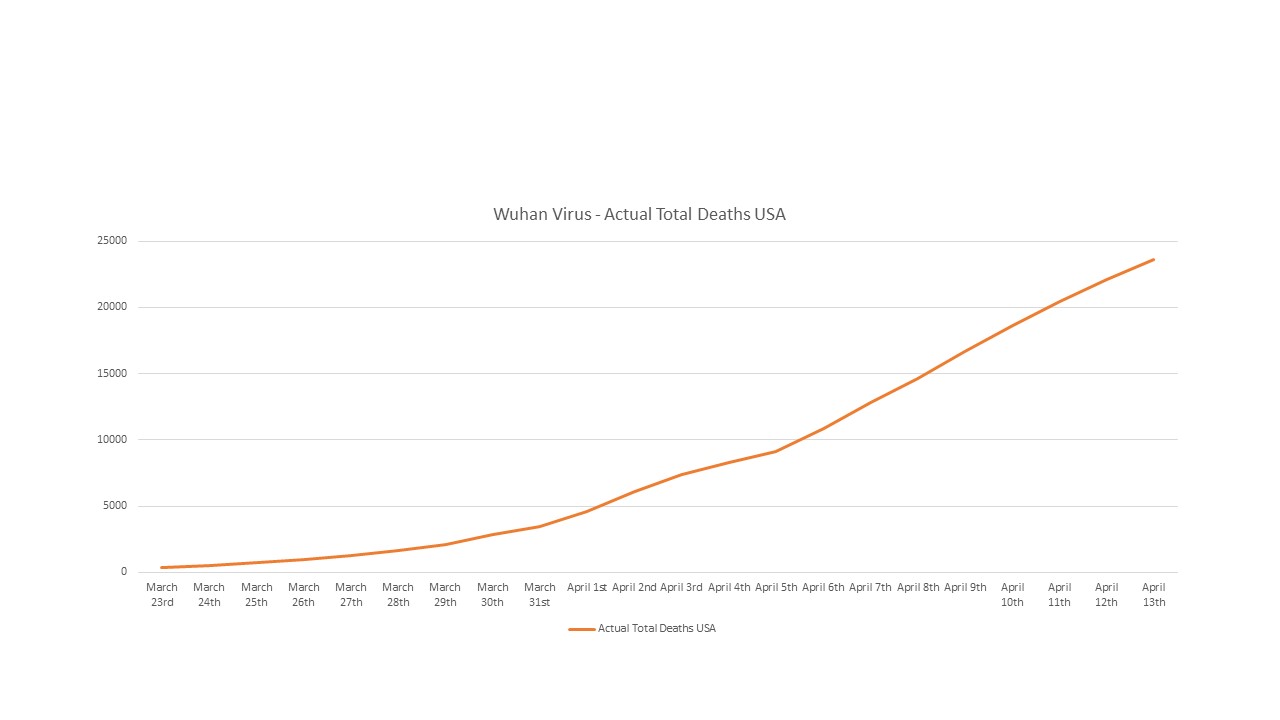
In this update I am posting graphics showing Jyotish Model projections for Active USA cases and total USA Deaths (first two graphics), followed by actuals up to April 13th (next two graphics). If you go back to my April 6th post and compare to what I have posted here, you will notice I have not tweaked my model projections at all. I am not looking to track levels / numbers of Active cases with my Jyotish model. What I am interested in tracking is how well this Jyotish based model is able to predict when the Active cases peak and when the declines start in Active Cases in USA. I notice a beginning of a slow down in the Active cases graph. Your constructive comments and suggestions are welcome on this post are welcome.

Current Cases and Total Recoveries to Date USA 200406

Jyotish Model Predicted Current Active Wuhan Virus Cases in USA March – May 2020

Jyotish Model Predicted Total Deaths 200406

Jyotish Model Predicted Total Wuhan Virus Deaths in USA March – May 2020


Actual Active Cases to April 13th 2020

Actual Active Wuhan Virus Cases USA to April 13th 2020

Actual Total Deaths To April 13th 2020

Actual Total Wuhan Virus Deaths in USA to April 13th 2020

The 2020 Memetic Pandemic in USA

Devi Cover for Outsider European Enlightenment Kindle 190506

WIth the Devi’s Blessings. Cover art by Jayant Kalawar 2018.

Most of us are already familiar with the genetic pandemic that is sweeping  through USA, at the time of this writing, in 2020. It is known variously as the Wuhan Virus, Covid – 19 and Corona Virus pandemic. I call it the Wuhan Virus RNA genetic pandemic, since it is driven by RNA, a basic genetic component of living cells. That way I can more clearly articulate the proposition that in parallel a memetic pandemic took place in USA in the February to April 2020 time frame. This memetic pandemic worked its way through the Global Social Mind that I began referring to in my previous post. The impact of this memetic pandemic may have been to temporarily amplify fears and cause confusion, and therefore lower the ability to effectively to respond to the genetic pandemic. From Jyotish perspective, the memetic pandemic is set to begin abating from April 7th 2020 on wards. And with that the Global Social Mind is likely to begin coming together to positively resolve the genetic pandemic.

Living in New Jersey I am currently experiencing (again at the time of this writing) the isolation and fears that arises from this Wuhan Virus pandemic. I know of people in my friends and family network who have been impacted from mild to critical to the ultimate price that this virus extracts. I write this analytical essay keeping those in mind. I hope I have nuanced it, so that it does not come across as cold and calculating. Hopefully the short term nature and order of magnitude lower numbers that this Jyotish based model projects comes true.

Viewing the 2020 USA Memetic Pandemic from the Jyotish Lens

On January 31st 2020, President Trump placed severe restrictions on airplane flights from China to USA. That was the beginning of USA memetic pandemic around the Wuhan Virus. It was the day that transit Mercury, which especially for USA governs analysis, communication, initiatives and short-term travel (Mercury thus ends up being a key significator of memes generated in USA), entered Aquarius, which happens to be the 8th House of death like experiences for USA according to SAMVA chart. This particular transit of Mercury through 30 degrees of Aquarius was longer than usual. Mercury went from 0 degrees Aquarius to almost 30 degrees, slowed down and came back to about 4 deg Aquarius and then trudged back to 30 deg by April 7th.  Mercury usually crosses a zodiac sign in 18 to 21 days. This time it stayed in Aquarius for 68 days[i]. Additionally, both natal Ketu and transit Ketu aspects were present in Aquarius at about 10 degrees and 16 degrees. Ketu gives isolation, distance and general material loss (and spiritual gain).

Thus, this transit of Mercury from January 31st to April 7th , manifested as memes of death like behavior, woven in with memes of isolation and distance. The Global Social Mind which has come into existence in the last 25 years, amplifies these memes and motivates individuals to according to the memes it propagates. We experienced the push towards social distancing and isolation after February 15th when Mercury began to slow down and retrace back from 20 deg Aquarius, in the shadow of natal Ketu. The Wuhan virus outbreak in Kirkland, Washington, had begun to unfold then and the first of the deaths in USA began to be counted.

From April 8th to April 25th, Mercury transits Pisces, the 9th house of good fortune and openness to direction from advanced research. We may likely see a different set of memes arise in this period. They are, however, likely to be over all weakly positive (and especially so up to August 14th): the memes in this period will likely begin giving information about how the pandemic is being mitigated and calling to action and getting back to work.

Mercury enters Aries on April 26th 2020. It will be able to manifest positive memes especially up to May 6th. Memes calling for action to get the economy moving may get stronger in this period. This may potentially effectively move the Global Social Mind out of the dark memetic pandemic, at least in the USA. May 8th on wards there are other Jyotish impacts seen from the political and economic frames that may not fully enable the positive memes trend to continue. We may talk about that in a later post.

Jyotish Perspective of Triggers for the RNA Pandemic in USA

In my continued attempts to make Jyotish a relevant tool in the modern world, I have used Jyotish based prediction as a driver of Covid-19 reproduction rate in US in the late March – early May time frame to forecast current cases, total deaths and total recoveries. I used actuals for March 21st as a starting point and then applied changing reproduction rates (using Excel spread sheet) as follows:

Jyotish Model Driving COVID 19 Reproduction Rate in USA March – May 2020 Using USA SAMVA CHART
Dates March 31st April 8th April 14th April 25th
Significant Astro Dates (Used as Drivers to change Reproduction Rate R in Table below) USA SAMVA tr Mars afflicted by tr Saturn Peak March 31st Gives Peak R=4.5) April 8th: tr Mars no longer afflicted. Tr 3rd L Mercury out of 8th H, but debilitated so only few openings for movement and communication opened up. Drives R down to 3.2 and then to 1.1) April 14th: Tr 2nd L Sun exalted in Aries bringing leadership and sense of well being to country. Drives R to 0.7. April 25th: Mercury moves into Aries. Movement, communication and innovation opens up. Drives R to 0.4 and lower in following weeks.


Following Charts present the Jyotish Model Forecasts and Actuals to Date (March 28th 2020)

Current Cases and Total Recoveries to Date USA 200406

Jyotish Model Predicted Current Wuhan Virus Cases

Jyotish Model Predicted Total Deaths 200406

Jyotish Model Predicted Total Deaths

Actual Total Cases 200406

Actual Total Cases

Actual Total Deaths 200406

Actual Total Deaths


I expect the numbers predicted will differ from actuals. My predictions are for total current cases net recoveries. Actuals are for total cases to date (not netted for recoveries). More important is when the actual cases and actual deaths peak and decelerate (and at what rate). So, what I would be looking for is whether the actuals begin to slope downwards as per prediction based on my Jyotish based model, between April 18th and April 25th and then slope downwards even further after between April 25th – May 2nd and accelerate downwards between May 2nd – May 9th. And whether total number of deaths stabilize around April 25th on wards. Lets see.

I use the Systems Approach To Vedic Astrology (SATVA) as propounded by Professor V. K. Chaudhry in the 1990s. Current SATVA practice is led by esteemed astrologer Mr. Rajesh K. Chaudhary. The USA chart that I refer to in this post was formulated after over a decade of detailed of historical research by Cosmologer.


[i] I hasten to add, that this description of Mercury’s travel through Aquarius is from a Earth positional astronomy perspective i.e. this is how we see Mercury’s motion in the sky from the Earth. Helio (Sun) centric astronomy teaches us that is not actually happens in space. Jyotish uses sidereal positional astronomy, with positions of planets and stars as they are seen from a point on Earth to cast sky maps (charts) and then interpret them using heuristics developed over millennia of observations.

Letting Go, Building Anew: On Becoming a Somewhat Better Person in 2020

Sri Gayatri MAtA by Raja Ravi Verma Source Wikipedia

ॐ श्री मात्रे नमः Source: Illustration by Raja Ravi Verma as published at https://en.wikipedia.org/wiki/Gayatri

By Jayant Kalawar, January 2, 2020

Like clockwork, 2019 has passed us by.

Left us memories of pleasures,

accomplishments and excitements.

Of moments of joy and peace

and exhilaration.

Of disappointments and sorrows,

frustrations and anger.

Deepening some connections,

Beginning new ones.

Weakening some, severing others.


What do I want to keep? What to let go? What do I want to build anew?

Well, actually if I could, I would like to keep just a few specific positive memories from 2019 and let go of the rest, both positive and negative.

I don’t think it is possible to let go of memories. But maybe be they can be moved to some faraway distant storage?! That way they are not lurking around to trigger us every day into doing or saying things that we then regret.

So I begin by thinking backwards from December to January of 2019. Month by month.

For each month I try to remember things that happened that gave me a feeling of well-being and of unease. I think of my health and in my late 60s I have some aches and pains that routinely spring to life. Remembering specific things helps to contemplate on what I should have done differently to manage these little friends that keep springing up. This way I begin to make a ‘lessons learned’ list! I have been able to add a new 3 minute daily exercise for my knees, for example. So I can move my memories of knee pain and weakness away into deep storage and instead add this new exercise segment into my daily activity.

I do the same, to remember the times I may have been upset with my dear and near ones, as I go back in the year, month by month. What could I have done differently so that I would not get so upset? And repeatedly so. The pattern becomes more obvious when I go through such a contemplative exercise for each of the 12 months. Beginning of a new year is a good time to do this, quietly by one self. I learn from it. It is one thing to say I should be more patient. Another to learn for one self how to say something differently, not jump to conclusions for example. Or come up with solutions. Asking more open ended questions in a way that would be less irritating, perhaps. So again, to let go of the memories of the pattern of upsets and hopefully to learn how not to repeat that pattern in 2020.

And then there is problem-solving we all do every day. Whether at home or at work or at play. This is something I particularly like to contemplate on. To see what problem solving was difficult for me. What caused anxiety and how was it resolved. How could I have done that problem solving differently. Much of the problem solving we do is collaborative. Going to buy or sell a car for example. To solve that problem requires many different players and many different factors coming into play. I have to come up to speed on who does what and so on in the car buying or selling process. Lots of prep work needs to be done before going in and engaging to solve the problem of buying or selling a car. Same thing with investing: buying or selling stocks or bonds for example. Or buying or selling a house. Same rules apply: contemplate on specific problem solving events backwards month by month in 2019. What could I have done differently to have better outcomes? What can I learn from that and how can I change how I solve problems in 2020? More research, patience, asking questions, being pro-active are some general things. All this take more time. So giving more time up front in how I plan the problem solving process is something that I hope to build in to the way I solve complex problems in 2020.

Hope you get some idea from these examples of my own step by step attempts to learn from 2019, so I can move most of the memories into far away distant storage while keeping most of the lessons learned. And so, hopefully, become a somewhat better person in 2020 (my new year’s resolution). Perhaps you may try some of this for yourself. Especially if you believe there is room for you to be a somewhat better person in 2020.