A Tiny Spark of Desirous Energy: A Contemplation

Tiny Spark of Desirous Energy 180208

Contemplating Desire (Photo by Wil Stewart on Unsplash)

By Jayant Kalawar

Embedded in dense vibration

A tiny spark of desirous energy

Seeking a stage to act.


Visualizing space-time stage

Many scripts playing

In many theaters

So many plays to choose from.


Choice made, birth taken

Name given

Script taught

Role rehearsed.


Acting out desirous energy

Immersed in role

On space-time stage.


New desires layered on

Dense vibration forgotten

Pleasures of desires

Fears of loss.


Music stops, role ends

Exit space-time stage

Grieving the loss

Many desires remaining.


Back to dense vibration

A tiny spark of desirous energy arising

Seeking a stage to act…

(c) 21BanyanTree and Jayant Kalawar

Delicious Desire: Making Sense of the ‘Nutella Riots’ in France

Hazelnut Nutella Riots

Delicious Desire (Source: Photo by NordWood Themes on Unsplash)

On the morning of January 26th 2018, BBC News reported rioting after a chain of supermarkets in France announced a deep discount on Nutella:

A discount on Nutella has led to violent scenes in a chain of French supermarkets, as shoppers jostled to grab a bargain on the sweet spread.Intermarché supermarkets offered a 70% discount on Nutella, bringing the price down from €4.50 (£3.90) to €1.40.But police were called when people began fighting and pushing one another.”They are like animals. A woman had her hair pulled, an elderly lady took a box on her head, another had a bloody hand,” one customer told French media.

It was surprising to read of this behavior in a country that is extolled worldwide for its superior cuisine, wines and desserts, not to mention a culture that is based on acting out the principles of civilized, secular science. The video, embedded in the news, shows healthy, well dressed and not starving individuals of Northern European extraction, (not newly arrived unwashed immigrants), who came to blows over the price of a processed food like Nutella.

In this instance, we can rule out desire arising out of biological hunger as a driver. Also, an attachment to tradition and heritage as a dynamic, was not in play here. Addiction to sugar and chocolate? Perhaps, especially when it is deeply discounted by 70%.   This may well be the trope for the 21st century consumer, programmed as we are by advertising and marketing memes to look for discounts and consume brand name processed foods, that make us acquire desires in the current socio-cultural milieu.

Desires and Fears

At any moment, our actions are driven by a combination of our personal desires and fears that are constantly interacting with the fears and desires of others around us.  In the microcosm, as we saw in the Nutella ‘riots’, desires play out as acquiring a commercially processed food at a low cost, on one hand, with the fear of losing out on the deep discount, on the other,

Then, there is the ladder of fall, when apparently civilized adult humans lose their capacity for judgement.   Modern biology tells us that humans use their forebrain to make judgements, and the capacity to make sound judgements kicks in fully by the age of 26. If this is true and the Nutella ‘rioters’ were, from the video, apparently much older, what went askew with their judgement capacity?

The Downward Spiral

My ancient tradition tells me that when desires are not met, we lose the capacity of judgement. The ladder of fall is described in these following steps:

  • When our energies attach themselves to an object that identifies our well-being, the desire arises to acquire, control and consume that object [Nutella].
  • When these desires are not met as expected (more on expectations in a later blog post), it leads to frustration [not getting our hands on the deeply discounted Nutella].
  • Frustration [of desire being unfulfilled] leads to anger.
  • Anger leads to loss of judgement [apparent loss of access to forebrain capability].
  • Loss of judgement leads to violence. This was in ample evidence in the video in the linked article.

What we see, in the relatively less hurtful and harmful microcosm of the ‘Nutella riots’, can happen to any of us individually, and amplified into group dynamics: desires not met to our expectations, rising frustration not resolved, mounting anger looking for action, culminating in indiscriminate violence and hurt.

Does this feel familiar to you, in your immediate surroundings and in the country you are living in, as well?

(Some of you may have recognized that I am referencing the Bhagavad Gita, chapter 2, verses 62-63, when I reference the downward spiral from my ancient traditions above).


Navigating Ambiguity and Uncertainty in 2018 and Beyond

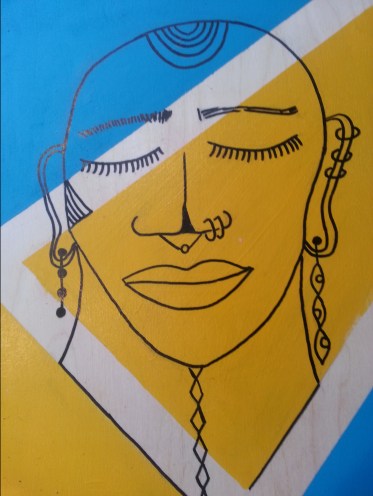
DEVI IN MEDITATION (c) ANUVA KALAWAR December 2018

Devi in Meditation (c) Anuva Kalawar December 2018

Coming as I do from a deep and strong tradition of connecting with the Devi through contemplation, chanting and meditation, I use the lens of the ‘pre-modern’ to view the rational modern social and economic world I inhabit. This enables me to come up with different ways to navigate ambiguity and uncertainty than what can be found in the box of modernity.

The conceit of modernity dates to the publishing of The Leviathan by Thomas Hobbes in the mid- 1600s. Modern man or woman began to see him/herself as rational and, thus, more mature. Structured, deductive thinking was given higher value and became the core of what is known as the European Enlightenment. One of the central tenets of this philosophical framework is that nature is dead, inert, and lacking of any spirit and, therefore, the Modern man and woman can dominate and exploit it without regard to consequences.  The consequence of this philosophy is the modernity paradigm that has produced the capital intensive carbon-based economy we now live in.

The academic and scientific establishment arising out of the European Enlightenment framework have further broadened and deepened the social construct of Hobbes to reach every nook and cranny of our lives. One organic outcome of this framework is the assembly line processes of education with its increasingly singular focus on STEM (Science, Technology, Engineering and Mathematics). It has also influenced the approach to health care based on the view that our bodies are part of nature, hence inert. Emotions and intellect are to be seen as arising out of the organic cellular interactions. Increasingly nature of human agency came to be suspect: it was seen as an extension of the material.

The modern individual in the 21st century is programmed to see themselves and the world around them in a particular rational manner: to look for cause-effect processes, and wait for confirmation from academics and scientists to tell them what those are.   Individuals acting on any memes without the blessings of science and academia are considered pre-modern and superstitious – even child-like and dangerous

Reliance on academia or science has made us less and less equipped to deal with ambiguity and uncertainty.  Our individual agency has gradually been eroded and outsourced to a scientific establishment that has often been found to be hand-in-glove with big business.

Modern rationality structures time and space through contracts. It teaches us that everything has to be a time and cost bound contract, whether it is written or verbal. These ubiquitous social contracts began with the one that Hobbes proposed in mid-17th century, as the basis for the modern national legal framework. The expected outcomes of these social contracts have become our portfolio of desires and fears.

Social contracts drive our actions, and when they fail our expectations of these outcomes fail.  Desires related to the expectations from the social contract collapse and fears take over as we increasingly find ourselves face to face with uncertainty and ambiguity. We are less and less equipped to deal with areas of life that have less obvious rational structure.  And as the fragile framework of modern rationality buckles under us, both adults and youth are left traumatized.

For adults, such break down of social contracts may arise from loss of spouse, children, jobs, homes, cars are outcomes of events where major social contracts have collapsed at our personal level. These are the big traumas many adults face, as they wander into uncertainty and ambiguity, as the fragile framework of modern rationality buckles under them.

Besides major social contracts, we engage in the myriad daily mini-social contracts. One of these unending contracts is STEM education which allows for tracing of performance on a daily basis and provides outcomes in grades. Failures are inbuilt into the processes which implement such contractual system. The individual student who is at the receiving end of outcomes of STEM contracts is (irrationally) blamed for the failed outcomes by the rationally constructed structures. Because the rational STEM educational process itself is too narrowly programmed, just like old-fashioned computer code. It does not have a way to deal with the inbuilt failure points in its delivery system. The result is many students in the modern educational students may end up seeing themselves as failures.

How did this state of affairs arise in a framework that promises individual liberty and pursuit of happiness?

Techno-Optimism to the Rescue

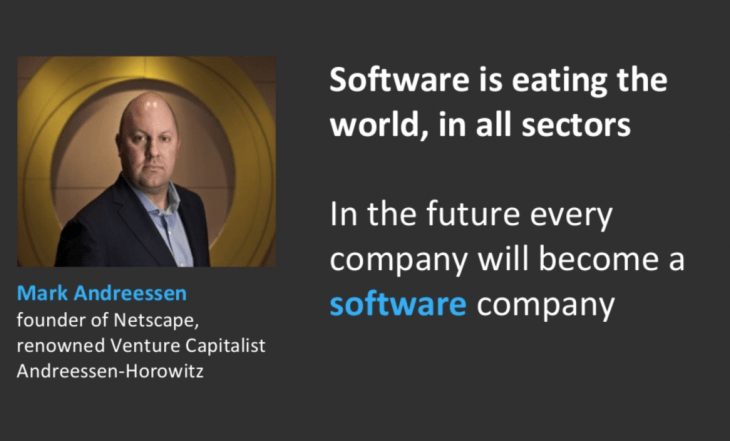
The ‘software will eat the world’ meme expressed by Marc Andreessen (designer – maker of the first user friendly web interface – Netscape – in the early 1990s and now a prominent Silicon Valley VC), and published in the Wall Street Journal in 2011, was peak of techno-optimism.

Post 2008 financial crisis and the great recession, techno-optimism became the savior paradigm. Software would eat the world: it would deliver goods and services to people much effectively and efficiently than people could. The consequence would be:

  • Labor would play increasingly smaller roles in creating and maintaining the social world.
  • There would be a move to universal basic income to ensure people do not starve and have basic minimum needs met.

STEM became the gospel to spread the good news of techno-optimism to the schools. Oracles were handed down from Silicon Valley.

In one fell swoop post 2008, funding for STEM streamed into public schools from the Federal and State governments. Testing schemes were put in place and educators ‘adapted’ to the new paradigm. Stories of student and teacher burn out began trickling out [in some schools teachers tried to bend the rules to help students pass tests.]

Eight years on, in 2016, social and economic ambiguity and uncertainty were still high: only a few young people were getting the high paying jobs in Silicon Valley and Wall Street. Most were floundering. Parents had adult children back at home after an expensive college experience. And software had not yet eaten the most dysfunctional sector of the economy: healthcare. The apparently massive systems solution put in place to support affordable health care ended up with confusion and higher costs for many, if not most, families.

The ‘software will eat the world’ meme has had its time on the national stage.

The new meme

We are now, in 2018, embedded in the make-America-great-again meme floated to take care of the social and economic ambiguity and uncertainty that we face. During the techno-optimism phase, stocks of companies such as Apple, Google (Alphabet) and Facebook rocketed up. Now, in very early 2018, all American company stocks are up with the make-America-great-again meme, making all who own stocks winners.

For the many who don’t own stocks or enough stocks, the ambiguity and uncertainty in the social and economic world we inhabit is likely to continue and increase. The trend towards automation is not going away. Global warming trends are not going away. And new geo-political realities of having more than one great power may not emerge without conflict.

Many of us carry this angst within us and it impacts our mental and physical well-being.  How can we cope with this angst and heal ourselves, regardless of what new major meme is played out in the rational modern world?

Come, sit with us under the BanayanTree

At 21BanyanTree you begin to explore how to live and thrive amidst the cacophony of confusion and deceit that seem to surround us. There are no guarantees. Nothing may change outside of us. What we will work together is on cognitive shifts inside of us. And to energize ourselves.

We use ‘pre-modern’ approaches and views of ourselves, the memes that modernity has shunned in the last 400 years. We do not throw the baby out with the bathwater but retain a carefully curated set of modern processes, technologies and solutions that integrate into our goals of a more harmonious and joyful life, even as we work hard to change our perspectives.

Our goal is to help manage desires and fears, using techniques that create more agency for ourselves at the individual and group level.

To explore this further, you can reach me at jayantkalawar@gmail.com.

Celebrating NatarAjA, the Dancing ShivA on ArdrA Full Moon January 1st 2018

As I write this, it is 5 deg F (-15 deg C) on the sunny morning of January 1st 2018, in the New York metro area. This new-year’s day will end with the Moon visible in full grandeur tonight at 9:15 pm (all New York time). The Earth is almost at the closest point to the Sun, in its elliptical orbit today at exactly 12:34 am, January 3rd 2018. The Moon will be at its closest in its orbit to the Earth today at exactly 4:48 pm, January 1st, 2018. Between the two will we get the Super Moon effect making for the Wolf Moon.

In my tradition of Jyotisha, and also more so especially in the Tamil tradition, the Full Moon that arises in ArdrA nakshatra celebrates the arising of the NatarAjA, the Dancing ShivA. (If you are not familiar with my Jyotisha tradition, please check out https://en.wikipedia.org/wiki/Nakshatra for a beginner’s orientation)

The significance of celebrating the Full Moon in ArdrA in Jyotisha is independent of calendars imposed and followed in the mundane world (for e.g., the European Gregorian calendar in use since 1582).

According to Jyotisha:

  • When the Sun begins transiting from midnight of December 21st (at 6:40 degrees in Gemini – the Sun transits opposite in Sagittarius at the same degree), it begins its apparent ‘movement’ North from the tropic of Capricorn.


  • When the ArdrA nakshatra is seen in the sky, we know the northward turn of the Sun has begun.


  • Since the ArdrA nakshatra spans Gemini from 6:40 degrees to 20 degrees, the Sun lights up ArdrA from December 22nd to January 4th.


  • The Full Moon that occurs during its transit in these degrees between December 22nd and January 4th is celebrated for the nritya of NatarAjA, the Dance of Shiva.

From a narrow modernist science perspective (not given to metaphorical contemplation) one may imagine the nritya of NatarAjA, the Dance of Shiva as NataRajA, as the movement of the entire range of energies that manifest the cosmos. Within the tradition, we see and experience the Dance of NatarAjA as manifesting creation, protection, destruction, release and embodiment.

The dance posture of NatarAjA is the focus of meditation on this Full Moon, with left leg lifted and suppressing ignorant ever transient tendencies (“this is mine”, “I did this” which in the globalized westernized culture and science these tendencies are bundled into the word ‘ego’) that arise in the embodiment under his right feet. The right hand of NatarAjA is in the posture of Abhaya Hasta, blessing meditators with protection in their meditation. The accomplished meditator visualizes the entire dance of the cosmos in the stillness of this posture.


In Tamil Nadu, this entire period is celebrated with exuberance of song and dance. Here is a link to just one small sliver of the spirit that exudes in the Tamil country during this season.


The Feminine and Masculine in Each of Us: Dancing with our Chakras

Reading my previous post may give the reader context for this post.

The Chakras and their Significations

There are six subtle energy centers, which we call chakras, aligned along the spine.

These centers channel energies, which then drive changes in the physical body, and actions by the physical body.

The energy combinations channeled through the six chakras, at any given moment, give rise to our actions.

The MooldhArA chakrA is the root center. Its energy drives actions to support the instinct to survive and grow physically.

The SwadhisTAnA is the creative and pro-creative center. Its energy drives creative energies, including pro-creative actions out of and within the physical body. It manifests as sexuality, which may be channeled both positively and negatively.

The MaNipurA is the acquisitive center. Its energy drives appetite for acquiring and storing all things material. It manifests as risk-taking behavior. It is sometimes described positively as courageous and ambitious and at other times as greedy and deceitful. In the negative it gives rise to actions based on fear.

The AnahatA is the emotional center. Its energy drives nurturing and affection on one hand. It can also give rise to the opposite: anger and hate.

The ViSuddhA center provides energy for articulation. Its energy drives vocalization and expression of the balance between the energies of the AnahatA and the AjnA centers. Depending on which of the two centers are more dominant, the ViSuddha will channel more emotional or more analytical expression.

The AjnA is the center for analytical intelligence. Its energy drives processing of information gathered by the 5 senses, comparison with memories of past experiences with corresponding actions directed at the action centers of ViShuddha, AnahatA, MaNipurA, SwadhishTAnA and MooldhArA.

The SahasrArA is the center for conceptual abstractions. Its energy drives the direction of the other six chakrAs described above, more towards spiritual, and relatively less towards the material.

Correlating Chakra significations with Gender: Role of the Physical Body

The female physical body manifests capability to pro-create and nurture. To activate these capabilities it draws upon the energies of the MooldhArA, SwadhishTAnA, MaNipurA and AnAhata.

When the female body is more focused on acting out its role of pro-creation and nurturing, its Vishuddha center expresses more emotion reflecting the active AnAhatA than the analytical energy of the AjnA.

The male physical body manifests capability to acquire and protect what it has acquired. It therefore draws upon energies of the MaNipurA and AnahatA (channeling those energies more towards determination and fixedness and competition, than towards nurturing and affection and collaboration), which it expresses through Vishuddha.

The entire range of energies are available to all physical bodies, whether female or male.

Which energies the body draws upon depends on which aspect is most open to be activated in a given phase in life and in particular social configurations and contexts:

  • Different phases in life e.g. whether in puberty and youth, vs in old age, for example.


  • Different social configurations e.g. whether in hunter-gatherer, agricultural, industrial or digital social configurations.

Social rules of thumb, in different social configurations, have been formed over time with general observations about what works best to sustain that particular social configuration.

These social rules of thumb, to enable sustenance of a particular social configuration, may lead to gender differentiated roles and expectations.

For example:

  • certain expected division of labor for pro-creation and maintenance of family, on one hand

and

  • acquisition and accumulation of material requirements for sustenance, on the other,

in an agriculture based social configuration

  • may have led to certain social rules of thumb of roles to be played by those with female bodies and those with male bodies.
  • This in turn would have led to the need to access different combination of chakra energies by female bodies, as compared to the male bodies.

As social technologies (i.e. how technology is used within a society) have changed, so have the social configurations and the possible roles played by individuals, whether with female or male bodies.

The lines between the social roles played by those with female bodies and those with male bodies may become blurred, especially as the need to for focus attention and energy on basic survival and pro-creation decreases, as we move from agricultural and industrial configurations to digital configurations, as we move from agricultural and industrial configurations to digital configurations.

When Gender Generalizations and Differentiations Do Not Work: Welcome to the 21st Century

As the demand for varying combination of chakra energies to survive, pro-create, acquire and accumulate decrease in a particular social configuration due to changes in social technologies:

  • individuals, with both female and male bodies, tend to move towards drawing upon the energies of AnahatA, AjnA and SahasrArA to express through the VishudhA.

The social technologies of the 21st centuries appear to be going, at least in early 2017, more towards the human body making less demands of both the basic survival and pro-creative energies from the MooldhArA and the SwAdhisTAnA. The acquisitive, accumulative energies still continue to be in demand, at the moment. We therefore see corresponding changes in how human bodies are acting: mostly by accessing MaNipurA (acquisitive), AnahatA (passionate determination) and AjnA (analytical intelligence). This configuration does not need to differentiate between male and female bodies.

Social roles based on gender differentiation focused on basic survival and pro-creation now make less sense.

Social context in practice of vibrational mantra for activating energy centers

Vibrational mantras (set apart from contemplative mantras) are practiced to activate specific energy centers.

The GAyatri mantra is a vibrational mantra, practiced to activate the AjnA energy, to enable access to analytical intelligence.

Practice of the GAyatri mantra on a daily basis over a sustained period of time may lead to more energy channeled towards analytical (AjnA) actions and relatively less energy towards survival (Mooldhaara) and pro-creative (SwadhisTAnA) actions.

The VishudhA expressions may also be more analytical and less compassionate and nurturing, by those practicing the GAyatri.

The GAyatri mantra practice, therefore, may not make sense to be practiced for those with female bodies, who wish to be mostly active in pro-creation and compassionate nurturing.

In the 21st century social configurations there are many with female bodies who do not find themselves in roles requiring long-term focus on pro-creation and nurturing.

They may be expected and required to perform roles which require sustained access to analytical energies.

The number of those with female bodies who will be playing these analytical roles may increase quite substantially in the next few decades.

Whether they will be assisted in their endeavors by chanting the GAyatri in a sustained manner in the long-term, is something that would need to be observed.

To sum up, ChakrA energy centers by themselves are gender neutral. The female and male physical body requires varying combination of energies from each of these energy centers in different phases of their lives, depending on the roles they are playing in the particular social context they find themselves in.

A well-designed comparative empirical study, of a carefully chosen test group and control group of women (and a similar parallel test and control groups of men), would certainly help to validate (or otherwise) the implicit multiple hypotheses, laid out in this article, about how vibrational mantras may impact male and female physical bodies differently.

The comments and suggestions from readers are welcome directly via email to the author at 21Banyantree@gmail.com .


KulAmrutarasikA: the 90th MantrA of the LalitAsahasranAmA

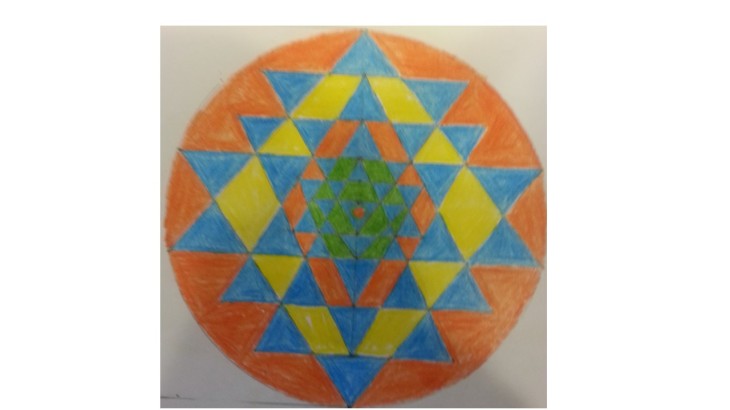
sri-chakra-image-from-121018

Sri Chakra representation drawn by Jayant Kalawar

By Jayant Kalawar

In the 22 mantras, spanning the 90th through 111, the LalitA SahasranAmA (those unfamiliar, please read this overview link) describes how LalitAmbA, Mother LalitA plays within us, as She rises from the MooldhArA to the SahasrArA.

The 90th mantra describes her at the top in the Sahasrara:

kuḷāmṛtaika rasikā

This mantra occurs in the 36th verse of the LalitA SahasranAmA, which is:

mūlamantrātmikā, mūlakūṭa traya kaḷebarā |

kuḷāmṛtaika rasikā, kuḷasaṅketa pālinī || 36 ||

(Listen)

The vibration of the mantra connect us to LalitAmbA, LalitA-Mother (AmbA). Listen to the link above and chant the mantra. You are calling out to the Devi LalitA, the Mother (Devi pronounced it as They-vi, for those unfamiliar with SamskrutA). And the Mother responds to your call.

Many of us though would like to know the ‘meaning’ of the mantra. That helps too, as it helps to create a visualization. How to chant a particular mantra with what focus and visualization is best as a one-on-one conversation. The vibration of the mantra along with the visualization can and does begin to change the vibrational structure of the individual. It is something to be learned when one is ready to begin connecting with the more subtle aspects of oneself, after gradually stepping away from the attachments of sense based objects.

Just to give a high level sense of the verse:

Rasika is the enjoyer. LalitAmbA is playing and enjoying. What is She enjoying?

Amrut: that which is opposite of Mrut, death. Non-Death. LalitAmba enjoys the state of Non-Death when She reaches the SahasrArA, where she meets and dances with ShivA.

Shiva is always sitting in meditation bathing in peaceful moonlight at the Sahasrara. Awaiting his beloved LalitAmbA to join Him.

LalitAmbA works through a series of obstacles to rise from the MooldhArA to meet her beloved ShivA in SahasrArA.

She awakens Him out of his meditative state in the Sahasrara. They begin their celestial dance.

And the Amrut, Non-Death, flows in the subtle plane.

In the physical plane it flows out of Kula: the body.

Hence, the practitioner tastes the sweetness when the Devi Shakti reaches the SahasrArA. It  flows as KulAmrut.

For LalitAmbA is indeed the RasikA, the enjoyer, of KulAmrut.  Hence KulAmrutaikarasikA.

The reader may have noticed, in the description above, how gender apparently seems to play a role. The feminine principle, LalitA rises to meet the male principle, Shiva.

Where does this take place? In each of our individual subtle bodies. So in that sense, each one of us has something that we may categorize as feminine and also masculine.

It is the meeting of these two principles within each of us culminates in the subtle celestial dance, which produces the A-Mruta, the Non-Death state.

It is also interesting to note that the 1000 mantras of LalitA are roughly divided, in terms of gender ascription, into one third feminine gender nouns, one third masculine gender nouns and the rest as neuter gender nouns.

Many of you may be interested to know more about how both the feminine and masculine principles play a role in each of us. I have written more about that here.


Connecting Your ChakrAs to the Thousand MantrAs

First let us chant the shAnti mantrA, which many of us are familiar with:

purnam adah, purnam idam purnat purnam udachyate; purnasya purnam adaya purnam evavasisyate (Brihadaranyaka Upansidhad 5.1.1, which is part of the Shatapatha Brahmana, which is part of the Shukla Yajur Veda)

This verse is repeated in Isha Upanishad (part of Shukla Yajur Veda) as the first verse.

There are various interpretations of this verse. I leave it to the reader to do a web search to get these range of interpretations.

This is my interpretation: what is in the entire cosmos is fully embedded in each micro element, and any composite set of micro elements that we perceive and interact with. I take this as an axiom. I call it the Fullness axiom. Rest is my proposition, arising from this axiom, as applied to specific word descriptions in the Lalita SahasranAmA. The proposition suggests actionable knowledge for you. To help you understand your own nature and have better sense of how to navigate through your world of experiences. Hence what follows may be of interest to you.

The Proposition

Our human body is just such a composite of micro elements. Applying the Fullness axiom, in principle the human body contains all that is in the entire cosmos. Let us view the human body as being made of multiple layers of chemical components moving about in space over time. These layers of chemical components interact with each other through neural vibrations.

The systematic descriptions of the world based on the Veda (known as ShastrAs) speak about three passages which connect the perineum area of the body to the top of the skull. Neural vibrations travel on these major highways. There are six interchanges on these highways, from which local networks lead to different parts of the human body. These six interchanges are called ChakrAs. The Lalita SahasranAmA (LS) specifically speaks of two speed bumps which slow down and serve as check points at each of the interchanges. Some of the interchanges have three check points. Getting past these check points requires the vibrations to have certain energy levels. Proper functioning of these check points and having the required vibrational energy levels are required to ensure smooth flow of neural vibrations throughout the human body. Blockages at these check points can lead to a dysfunctional human body.

In each of the articles linked below (I will add sporadically as I write and post on a mantra, as and when inspired by LalitAmbA), I take up one of 22 mantras, from the 1,000 mantras, in the LS. The 22 mantras span the 90th to the 111th mantra in the LS and describe how LalitAmbA manifests (and what results from such manifestation) as her energy travels the path from the MooldhArA to the SahasrArA.

The 90th MantrA: Kulamrutaikarasika is described at this link:

https://21banyantree.com/2017/02/24/kulamrutarasika-the-90th-mantra-of-the-lalitasahasranama/